

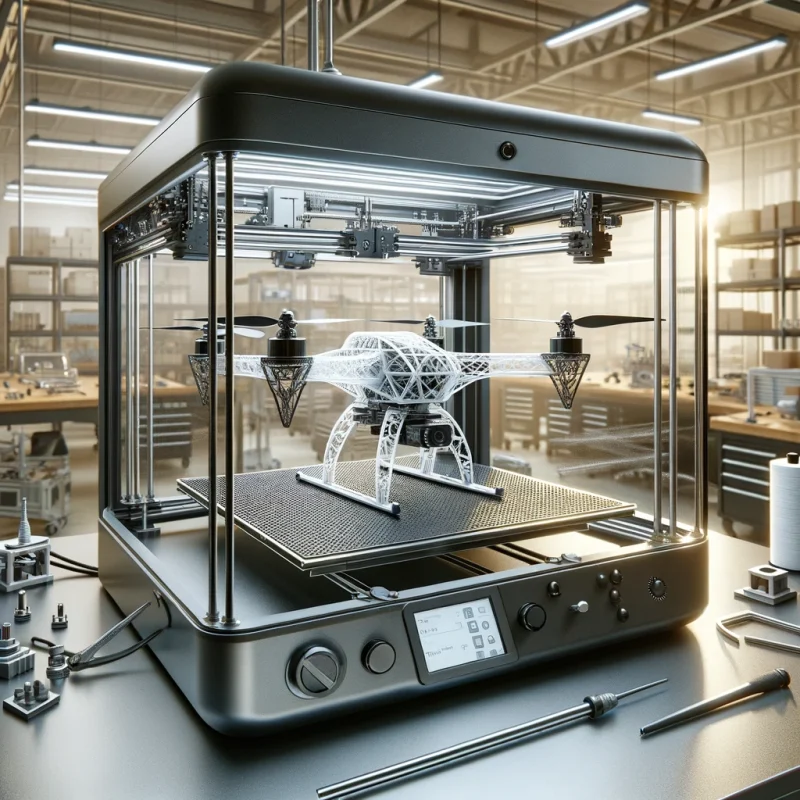
In the rapidly evolving drone industry, advancements in materials science and manufacturing techniques are setting new standards for performance, durability, and efficiency. Among these innovations, 3D printing technology, also known as additive manufacturing, stands out for its profound impact on how drones are designed and produced.

20
Mar
Mar
Although the aerospace industry has already created working eVTOL (electric vertical take-off and landing) vehicles that resemble the traditional saucer in shape, there is still room for innovation to expand and enrich this category of vehicles. The potential for innovation is far from being fully realised and the challenges facing designers, such as increasing range, improving energy efficiency and enhancing passenger safety, will continue to encourage engineers and developers to develop new solutions.

20
Mar
Mar
Dubai’s introduction of air taxi services by 2026, in partnership with Joby Aviation and Skyports Infrastructure, marks a significant advancement in urban mobility and is poised to have a transformative impact on the city’s economy, especially its tourism sector. This initiative will position Dubai as the first city in the world to offer a commercial, citywide electric air taxi service, thereby enhancing its reputation as a global leader in adopting futuristic transportation technologies.

19
Mar
Mar
Electric Vertical Take-off and Landing (eVTOL) aircraft represent a major leap forward in aviation technology, offering a novel approach to air transport that goes beyond the traditional operation of conventional aircraft. The safety benefits of eVTOL aircraft stem from their innovative design, redundant systems and operational environment, positioning them as a potentially safer way to travel in the future.

18
Mar
Mar
In the advent of groundbreaking advancements in aviation technology, the skies are set to become the next frontier of transportation, teeming with drones, flying cars, and Electric Vertical Takeoff and Landing vehicles (eVTOLs). This burgeoning traffic in the aerial domain necessitates a paradigm shift in air traffic management to maintain safety, efficiency, and fluidity. Enter the realm of autonomous air traffic control systems, a revolutionary approach harnessing the prowess of Artificial Intelligence (AI) and machine learning to redefine airspace management.

17
Mar
Mar
Airborne Wind Energy (AWE) systems represent a transformative approach to harnessing wind power, utilizing kites, wings, or drones to capture the energy found in higher altitude winds. This innovative technology is gaining traction as a potentially game-changing solution for sustainable energy generation, aiming to significantly lower the levelized cost of energy (LCoE) compared to traditional wind turbines.