

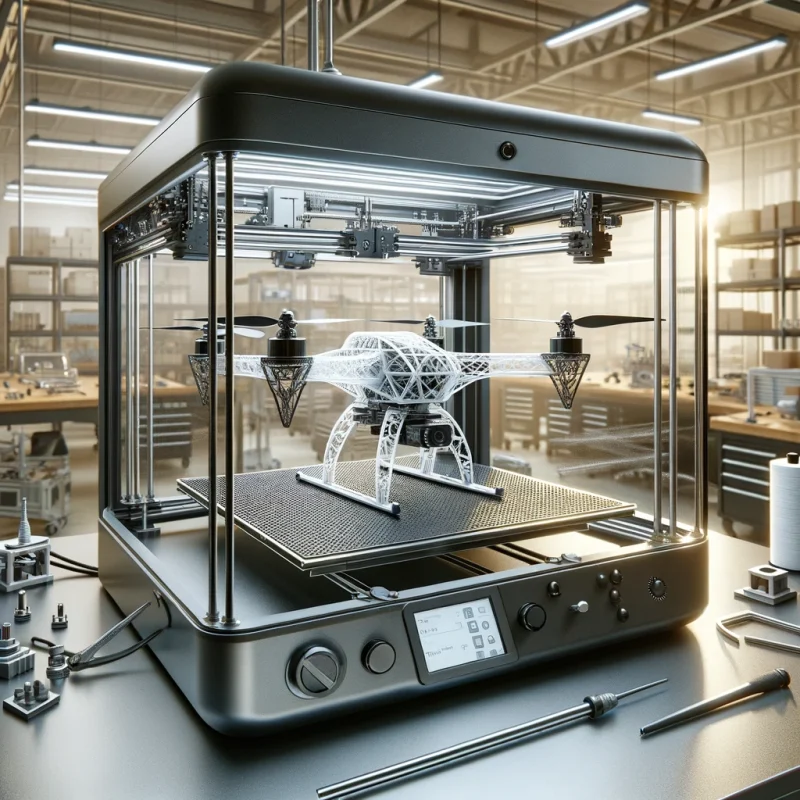
In the rapidly evolving drone industry, advancements in materials science and manufacturing techniques are setting new standards for performance, durability, and efficiency. Among these innovations, 3D printing technology, also known as additive manufacturing, stands out for its profound impact on how drones are designed and produced.
This shift towards more sophisticated manufacturing methods and the use of advanced materials is enabling drones to achieve longer flight times, carry heavier payloads, and access a wider range of applications than ever before.
The Revolution of 3D Printing in Drone Manufacturing
3D printing technology has revolutionized the production of drones by allowing for complex designs that were previously impossible or too costly to achieve with traditional manufacturing methods. The additive process of 3D printing, where material is layered to create objects, enables the fabrication of intricate components with precision and flexibility. This method reduces waste, lowers production costs, and significantly shortens the development cycle of drone prototypes.
One of the most significant advantages of 3D printing is its ability to work with a variety of materials, including lightweight polymers and composites, high-strength metals, and even bio-based materials. These materials can be tailored to specific properties such as strength, flexibility, and weight, offering unparalleled customization options for drone manufacturers.
Innovative Materials Elevating Drone Capabilities
Advanced composites are at the forefront of materials innovation in the drone industry. Carbon fiber-reinforced polymers (CFRP) and glass fiber-reinforced polymers (GFRP) are widely used for their high strength-to-weight ratios, enhancing the structural integrity of drones while minimizing their overall weight.
These materials contribute to increased payload capacity and extended flight times, crucial factors for commercial and industrial drone applications.
Moreover, the integration of nano-materials, such as graphene, is pushing the boundaries of what’s possible with drone technology. Graphene’s exceptional electrical conductivity, thermal properties, and mechanical strength open new avenues for improving battery efficiency, thermal management, and resilience of drones against physical stresses.
Towards More Energy-Efficient Drones
The drive for energy efficiency in drones is not only about enhancing battery life but also about adopting more sustainable practices within the industry. Advanced materials and 3D printing technologies are instrumental in developing energy-efficient propulsion systems and lightweight structural components, directly contributing to reduced energy consumption during flight.
The future of drone manufacturing lies in the continuous exploration and integration of emerging materials and technologies. Research into bio-based composites and recyclable materials is gaining traction, reflecting a growing commitment to environmental sustainability in the drone industry.
Implications and Future Directions
The advancements in materials science and manufacturing techniques hold promise for the expansion of drones into new markets and applications. From precision agriculture and infrastructure inspection to emergency response and environmental monitoring, the potential uses for drones are vast and varied. As drones become capable of longer durations in the air and handling more complex tasks, their integration into everyday life seems increasingly imminent.
Looking ahead, the drone industry is poised for further innovation. The ongoing development of smart materials, capable of changing properties in response to environmental stimuli, could lead to drones with adaptive aerodynamics for improved flight efficiency. Additionally, the exploration of biodegradable materials may pave the way for eco-friendly drones, aligning with global sustainability goals.
More articles you may be interested in...
Drones News & Articles
China’s automated logistics network exposes Western regulatory inertia
Drones News & Articles
The hovering sniper: China’s new rifle-drone achieves “deadly precision”
A recent report indicates that Chinese researchers have overcome one of the primary hurdles in robotic warfare: recoil management.
EVTOL & VTOL News & Articles
Sanghajt opens up to drones
From February, drones will be able to fly over designated areas without prior notification, with the local government seeing tremendous...>>>...READ MORE
Drones News & Articles
DJI agras series: a new era in autonomous agricultural robotics
Air taxi News & Articles
The great convergence: standardizing electric flight propulsion
EVTOL & VTOL News & Articles
The tethered sky: Navigating the integration of U-space and energy grids
News & Articles Propulsion-Fuel
Hydrogen’s regional mandate: Retrofitting the future of flight
EVTOL & VTOL News & Articles
Navigating the valley of reality: An AAM sector assessment
The Advanced Air Mobility (AAM) ecosystem has fundamentally shifted, transitioning from a period defined by...>>>...READ MORE
moreDrones News & Articles
Europe’s airspace awakens: The industrial reality of U-space 2.0
News & Articles Propulsion-Fuel
Hydrogen’s verdict: The 2026 propulsion shift redefining regional flight
News & Articles Propulsion-Fuel
Solid-state inflection: The 5-minute charge revolutionizing regional aviation
The nascent electric aviation sector currently faces a defining bottleneck that has less to do...>>>...READ MORE
EVTOL & VTOL News & Articles
The certification cascade: How Part 194 rewrites the rules of vertical flight
Drones News & Articles
Beyond Formula 1: engineering the 657 km/h Peregreen V4 drone record
In the realm of aerodynamics, the quadcopter configuration has traditionally been associated with stability and...>>>...READ MORE
moreEVTOL & VTOL News & Articles
EHang appoints Shuai Feng as chief technology officer
EHang Holdings Limited (Nasdaq: EH) (“EHang” or the “Company”), a global leader in advanced air mobility (“AAM”) technology, today officially announced that the Board of Directors of the Company (the “Board”) has approved and appointed Mr. Shuai Feng as the Chief Technology Officer (“CTO”), effective on January 14, 2026.