


The global automotive landscape is undergoing a profound reconfiguration, marked by the emergence of innovative entrants that challenge established paradigms with a focus on electrification and multimodal mobility. In this context, the introduction of XPeng Motors a Chinese electric vehicle manufacturer founded in 2014 into the Hungarian market represents a significant milestone.
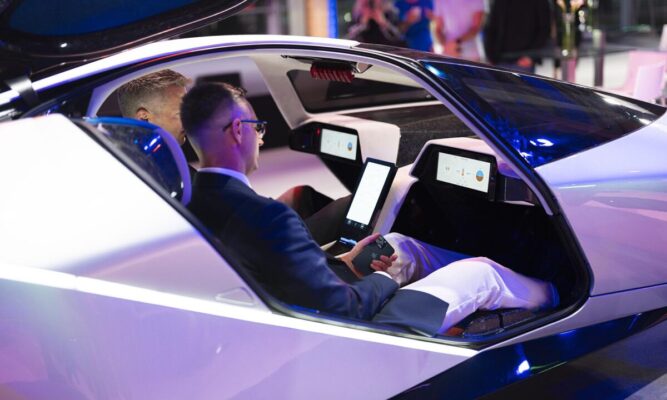
This debut, slated for fall 2025, extends beyond conventional ground-based vehicles equipped with an 800-volt architecture for enhanced charging efficiency; it also showcases an electric vertical takeoff and landing (eVTOL) prototype, heralding advancements in urban air mobility (UAM). Critically, while such integrations promise reduced urban congestion, they underscore the need for interdisciplinary scrutiny, blending engineering precision with psychological considerations of public trust in autonomous systems.
The aircraft of the future
At the heart of XPeng’s Budapest unveiling stands the X2, an eVTOL multicopter engineered by AeroHT, a subsidiary of XPeng dedicated to aerial vehicle innovation since its integration in 2020. This teardrop-configured, two-seat apparatus exemplifies distributed electric propulsion (DEP), a configuration leveraging multiple rotors for vertical lift and efficient cruising, as delineated in foundational eVTOL literature. Far from a mere conceptual sketch, the X2 functions as a validated technology demonstrator, having executed test flights including demonstrations in Dubai that affirm its operational viability.
From a scientific vantage, this progression aligns with the maturation of eVTOL from 2009 NASA conceptualizations to contemporary prototypes, yet it invites critical reflection on scalability: while DEP enhances redundancy, energy density constraints in lithium-based batteries limit range, necessitating hybrid architectures for broader adoption.
Psychologically, the allure of such “flying capsules” may foster aspirational mobility narratives, but journalists must probe equity issues, ensuring UAM does not exacerbate urban divides.
What’s in the engine room
The X2’s propulsion architecture employs eight electric motors driving coaxial rotors affixed to four extensible arms, a design borrowed from unmanned aerial vehicle (UAV) paradigms to optimize stability and fault tolerance. Constructed from lightweight carbon fiber composites, it achieves a maximum velocity of 130 km/h and endurance of 25 to 35 minutes, rendering it suitable for intra-urban hops under 50 kilometers.
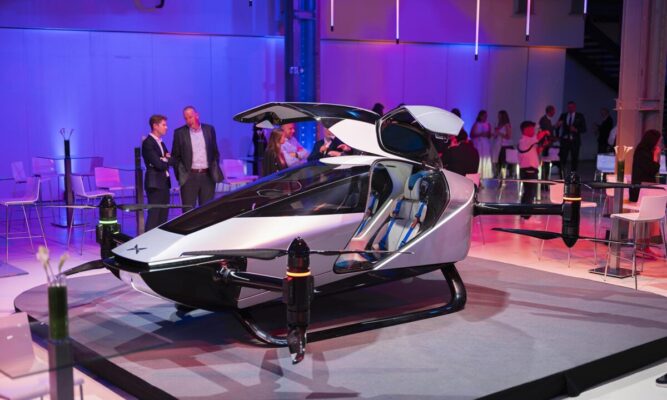
With a maximum takeoff mass of 560 kg, the semi-enclosed cabin prioritizes aerodynamic efficiency over full pressurization, a pragmatic choice for short-haul UAM. Its hallmark innovation lies in full autonomy, enabling geofenced waypoint navigation via integrated inertial and satellite systems.
Operationally, the interface distills piloting to a singular actuation for ascent and descent, with optional manual override, while layered redundancies spanning propulsion, avionics, and power distribution mitigate single-point failures. Complementing this is a ballistic recovery parachute, deployable via pyrotechnic ejection for whole-vehicle descent in extremis. Environmental perception draws from a sensor fusion array, including electro-optical cameras and millimeter-wave radars, facilitating real-time obstacle evasion through probabilistic mapping algorithms.
Professionally, as a programmer dissecting such systems, one appreciates the elegance of modular software stacks akin to ROS (Robot Operating System) frameworks; however, empirical validation through Monte Carlo simulations reveals that sensor latency could amplify risks in dense airspace, demanding rigorous verification protocols.
Scientifically, these features echo eVTOL’s evolution toward safety objectives under frameworks like the European Union Aviation Safety Agency’s Special Condition VTOL-01, yet regulatory harmonization remains a bottleneck for certification.
When can we see something like this in the sky?
Positioned as a proof-of-concept rather than a production-ready asset, the X2 illuminates XPeng’s strategic foresight in multimodal ecosystems, yet its proliferation hinges less on technological maturity now ostensibly resolved via iterative prototyping and more on socio-regulatory scaffolding.
Key impediments encompass vehicle type certification, airspace integration via unmanned traffic management (UTM) protocols, and infrastructure provisioning for vertiports, which entail zoning, noise abatement, and energy grid reinforcements. Critically, as a psychologist attuned to adoption dynamics, one observes that while eVTOLs evoke sci-fi optimism, latent anxieties over mid-air incidents could stall societal buy-in, necessitating transparent risk communication campaigns informed by behavioral economics.
XPeng is advancing toward a next-generation modular platform: a ground module comprising a six-wheeled, range-extended electric chassis paired with a detachable eVTOL upper stage akin to the X2, dubbed the “Land Aircraft Carrier.” Mass production facilities in China are under construction, with pre-order initiation projected for 2026, aligning with broader industry timelines for commercial UAM viability.
From a journalistic lens, this ambition signals XPeng’s pivot from terrestrial EVs bolstered by partnerships like Volkswagen’s 2025 E/E architecture collaboration to aerial domains, yet it warrants scrutiny: bold timelines often mask supply chain volatilities, as evidenced by historical delays in EV scaling. Ultimately, the X2’s Hungarian spotlight transcends automotive ingress, embodying a holistic mobility ethos that bridges terrestrial and aerial realms, inching closer to a congested future where seamless transitions redefine transit equity.
More articles you may be interested in...
Drones News & Articles
China’s automated logistics network exposes Western regulatory inertia
Drones News & Articles
The hovering sniper: China’s new rifle-drone achieves “deadly precision”
A recent report indicates that Chinese researchers have overcome one of the primary hurdles in robotic warfare: recoil management.
EVTOL & VTOL News & Articles
Sanghajt opens up to drones
From February, drones will be able to fly over designated areas without prior notification, with the local government seeing tremendous...>>>...READ MORE
Drones News & Articles
DJI agras series: a new era in autonomous agricultural robotics
Air taxi News & Articles
The great convergence: standardizing electric flight propulsion
EVTOL & VTOL News & Articles
The tethered sky: Navigating the integration of U-space and energy grids
News & Articles Propulsion-Fuel
Hydrogen’s regional mandate: Retrofitting the future of flight
EVTOL & VTOL News & Articles
Navigating the valley of reality: An AAM sector assessment
The Advanced Air Mobility (AAM) ecosystem has fundamentally shifted, transitioning from a period defined by...>>>...READ MORE
moreDrones News & Articles
Europe’s airspace awakens: The industrial reality of U-space 2.0
News & Articles Propulsion-Fuel
Hydrogen’s verdict: The 2026 propulsion shift redefining regional flight
News & Articles Propulsion-Fuel
Solid-state inflection: The 5-minute charge revolutionizing regional aviation
The nascent electric aviation sector currently faces a defining bottleneck that has less to do...>>>...READ MORE
EVTOL & VTOL News & Articles
The certification cascade: How Part 194 rewrites the rules of vertical flight
Drones News & Articles
Beyond Formula 1: engineering the 657 km/h Peregreen V4 drone record
In the realm of aerodynamics, the quadcopter configuration has traditionally been associated with stability and...>>>...READ MORE
moreEVTOL & VTOL News & Articles
EHang appoints Shuai Feng as chief technology officer
EHang Holdings Limited (Nasdaq: EH) (“EHang” or the “Company”), a global leader in advanced air mobility (“AAM”) technology, today officially announced that the Board of Directors of the Company (the “Board”) has approved and appointed Mr. Shuai Feng as the Chief Technology Officer (“CTO”), effective on January 14, 2026.