


Electric car manufacturer Xpeng has been making headlines with its ambitious entry into the flying car market through its subsidiary, AeroHT. The company is currently developing two distinct types of flying vehicles, one of which is being referred to as a Cybertruck-like model due for launch in 2025. Despite the name “flying car,” this vehicle will not take off in the conventional sense, but it will feature a unique approach to airborne transportation. The different prototypes and concepts highlight Xpeng’s vision of a future where the boundaries between road and air travel are increasingly blurred.
Land aircraft carrier: modular hybrid vehicle
Xpeng AeroHT first unveiled its flying car concept several years ago, initially targeting a release date in 2024. Since then, they have managed to maintain progress on this ambitious timeline, although there have been some adjustments to the design. A prominent example is the “Land Aircraft Carrier,” a modular vehicle presented at the 2024 Consumer Electronics Show (CES). While not yet available in prototype form, promotional videos have hinted at the vehicle’s features and versatility. Pre-orders for the Land Aircraft Carrier are set to begin later this year, with the first shipments expected next year.
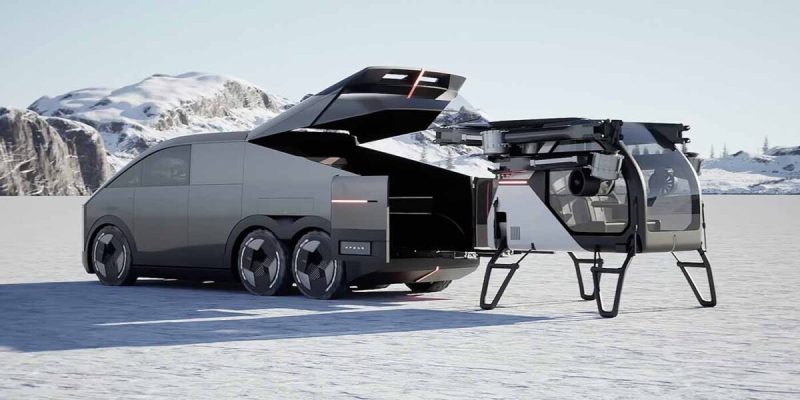
However, describing the Land Aircraft Carrier as a “flying car” might be a bit misleading. The vehicle more accurately resembles a combination of a rugged off-road vehicle—akin to Tesla’s Cybertruck—and an electric vertical take-off and landing (eVTOL) aircraft. It is equipped with an eVTOL drone that is stowed within the vehicle and can be deployed when airborne travel is required. This feature provides a seamless transition from road driving to flying, delivering a key advantage of flying cars: versatile mobility.
This modular technology could prove advantageous in regions where regulations governing flying cars are yet to be clearly defined. In China, for example, the legal framework needed for flying car operation is still in development. The hybrid nature of the Land Aircraft Carrier means that it can navigate on roads like a traditional car while also offering air travel, albeit through a separate detachable eVTOL, thus avoiding regulatory pitfalls. The modularity of the design makes it more accessible to users, providing a novel, yet pragmatic version of airborne commuting.
Design and features
The Land Aircraft Carrier showcases the same bold, angular design aesthetic that distinguishes the Cybertruck. Its exterior conveys robustness, and it emphasizes both resilience and versatility. Inside, a compact eVTOL drone can be easily retrieved from the vehicle’s cargo space. When the driver wants to switch to airborne mode, the eVTOL can be deployed in minutes to provide short-range aerial capability. In essence, the vehicle brings the concept of “sky-road hybrid” to life, but in a different manner than many would expect. Instead of a car that sprouts wings or propellers, it’s a car that carries a deployable flying device, similar to an airborne drone.
The technological simplicity of this concept is perhaps its greatest strength. Unlike full-fledged flying car designs, which require sophisticated technology for vertical take-off and flight stability—making them highly regulated and complex—the Land Aircraft Carrier offers a straightforward solution. Owners can drive on roads without the stringent requirements typically applied to aircraft and only fly in areas where the eVTOL component is permitted. This compromise may well help accelerate adoption while reducing legal complexities.
The “world’s first fully electric eVTOL flying car”
Xpeng AeroHT also showcased another, more futuristic vehicle model at CES: the “world’s first fully electric eVTOL flying car.” Unlike the modular Land Aircraft Carrier, this vehicle embodies the concept of a fully integrated flying car—a car that converts directly into an aircraft. The display model matched the sleek, cutting-edge designs typically seen in concept animations, complete with fully functional, retractable propellers that allow the vehicle to transition between driving and flying modes seamlessly.
Earlier prototypes and development
The journey to this model can be traced back to Xpeng AeroHT’s earlier prototypes—the X2 and X3. These prototypes have already undergone a series of successful flight tests, demonstrating the feasibility of the eVTOL technology. Although they were rudimentary compared to the model showcased at CES, they served as important stepping stones in developing a more practical flying car.
The latest model on display at CES is distinguished by its retractable propellers, which are stored at the rear of the vehicle. Unlike traditional flying car designs that tend to have permanent, cumbersome aerial structures, the Xpeng AeroHT keeps the propellers concealed until needed, allowing for more streamlined ground movement. At the press of a button, the propeller unit unfolds in seconds, converting the car into a flying machine capable of taking off vertically. This flexibility helps overcome a key challenge for urban mobility—navigating congested roads with the option of switching to aerial travel.
Future availability and pricing
Although the full-fledged eVTOL flying car prototype garnered significant attention, Xpeng has no immediate plans to bring this model to the market. Xpeng President Brian Gu hinted that, if released, its price would be comparable to that of a luxury car—possibly putting it in the same category as vehicles like the Mercedes-Benz S-Class or Porsche Taycan. This price point suggests that, at least initially, the market for this type of technology will be limited to affluent buyers willing to invest in futuristic personal transportation.
The delays in rolling out this model also highlight the regulatory hurdles that must be cleared for flying cars to become commercially viable. Airspace regulations, safety certifications, and urban infrastructure adaptations are all challenges that need to be addressed before such vehicles can be launched for everyday use. In the meantime, Xpeng’s efforts with its modular Land Aircraft Carrier seem like a prudent step—giving users a taste of hybrid sky-road transportation without the full regulatory burden.
Broader implications for urban mobility
The development of flying cars by companies like Xpeng AeroHT represents a significant step towards a future where urban mobility is more efficient and dynamic. As cities grow more congested and traditional road infrastructures reach capacity, aerial mobility solutions like eVTOLs offer a promising alternative. The appeal lies in the ability to bypass traffic bottlenecks and reduce overall travel times, which could make urban centers more liveable and less polluted.
However, challenges remain—from engineering complexities to infrastructure requirements and regulatory frameworks. Airspace management in urban areas will require sophisticated systems to handle the additional layer of traffic. There are also safety considerations related to flight over populated areas. Technologies like autonomous navigation and collision avoidance will need to be perfected to gain public trust.
Moreover, questions of energy efficiency and sustainability also arise. Xpeng’s focus on fully electric systems positions their vehicles well, considering global efforts to reduce carbon emissions, but the overall environmental impact of widespread eVTOL use will depend on the sustainability of battery technology and energy sources.
Despite these hurdles, the efforts of companies like Xpeng AeroHT, Volocopter, and Joby Aviation are pushing the boundaries of what personal transport can look like in the 21st century. By combining advanced electric propulsion systems, artificial intelligence for flight control, and unique hybrid concepts like the Land Aircraft Carrier, they are bringing science fiction closer to reality.
Notes and highlights
Source: asia.nikkei.com
More articles you may be interested in...
Drones News & Articles
China’s automated logistics network exposes Western regulatory inertia
Drones News & Articles
The hovering sniper: China’s new rifle-drone achieves “deadly precision”
A recent report indicates that Chinese researchers have overcome one of the primary hurdles in robotic warfare: recoil management.
EVTOL & VTOL News & Articles
Sanghajt opens up to drones
From February, drones will be able to fly over designated areas without prior notification, with the local government seeing tremendous...>>>...READ MORE
Drones News & Articles
DJI agras series: a new era in autonomous agricultural robotics
Air taxi News & Articles
The great convergence: standardizing electric flight propulsion
EVTOL & VTOL News & Articles
The tethered sky: Navigating the integration of U-space and energy grids
News & Articles Propulsion-Fuel
Hydrogen’s regional mandate: Retrofitting the future of flight
EVTOL & VTOL News & Articles
Navigating the valley of reality: An AAM sector assessment
The Advanced Air Mobility (AAM) ecosystem has fundamentally shifted, transitioning from a period defined by...>>>...READ MORE
moreDrones News & Articles
Europe’s airspace awakens: The industrial reality of U-space 2.0
News & Articles Propulsion-Fuel
Hydrogen’s verdict: The 2026 propulsion shift redefining regional flight
News & Articles Propulsion-Fuel
Solid-state inflection: The 5-minute charge revolutionizing regional aviation
The nascent electric aviation sector currently faces a defining bottleneck that has less to do...>>>...READ MORE
EVTOL & VTOL News & Articles
The certification cascade: How Part 194 rewrites the rules of vertical flight
Drones News & Articles
Beyond Formula 1: engineering the 657 km/h Peregreen V4 drone record
In the realm of aerodynamics, the quadcopter configuration has traditionally been associated with stability and...>>>...READ MORE
moreEVTOL & VTOL News & Articles
EHang appoints Shuai Feng as chief technology officer
EHang Holdings Limited (Nasdaq: EH) (“EHang” or the “Company”), a global leader in advanced air mobility (“AAM”) technology, today officially announced that the Board of Directors of the Company (the “Board”) has approved and appointed Mr. Shuai Feng as the Chief Technology Officer (“CTO”), effective on January 14, 2026.