

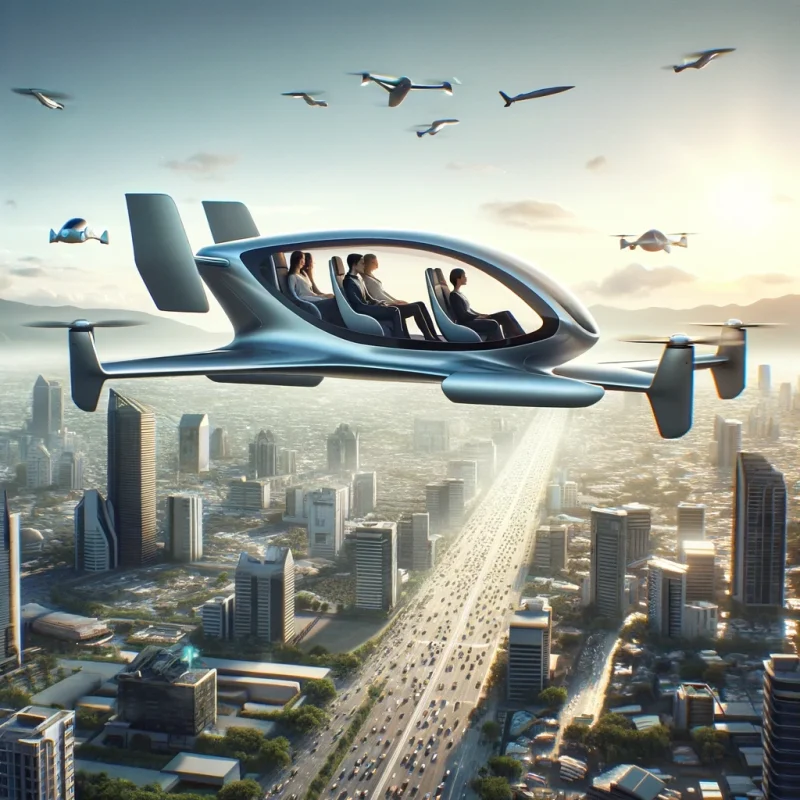
The future of urban air mobility, particularly with electric Vertical Takeoff and Landing (eVTOL) vehicles and flying cars, is on the brink of transforming transportation as we know it. Enthusiasm for this technology is not unfounded, given the rapid advancements in battery technology and electric propulsion systems, as well as increasing interest from companies and governments worldwide.
However, widespread adoption will hinge on several factors, including technological progress, regulatory frameworks, public acceptance, and the economic viability of these vehicles.
Technological Viability and Adoption Rates
McKinsey’s insights suggest that by 2030, electric aircraft could become a popular mode of transportation, offering a sustainable alternative to traditional taxis. Public acceptance may grow over time, especially as the technology proves itself to be safe and reliable. It’s expected that 15 to 20 percent of people across various geographies can definitely imagine switching from their current mode of mobility to a flying-taxi service in the future.
This indicates a significant portion of the population is open to using eVTOLs, which could translate to a multibillion-dollar market opportunity as these vehicles begin to capture shares of the global taxi and e-hailing markets.
Economic and Manufacturing Considerations
The economic sustainability of flying cars and eVTOLs is contingent upon achieving economies of scale and overcoming manufacturing challenges, such as the development of lightweight, strong composite materials. The transition from automotive to aviation manufacturing methods will be crucial for scaling up production while ensuring safety and reliability.
Regulatory and Cybersecurity Challenges
The integration of flying cars into urban environments will require comprehensive regulatory frameworks to ensure safety and cybersecurity. The operation of these vehicles will rely heavily on advanced computational AI and Detect and Avoid (DAA) technologies. Establishing robust cybersecurity policies and standards will be critical to protect these vehicles from cyber threats.
Battery Technology: The Key to Feasibility
A pivotal factor for the feasibility and success of eVTOLs is battery technology. Current lithium-ion batteries have reached a stage where they can power eVTOL aircraft for short ranges. However, for these vehicles to become a practical and widely used form of transportation, further improvements in battery power and energy density are necessary.
Companies like Archer Aviation and Kitty Hawk are already demonstrating prototypes that hint at the near-term potential of urban air mobility, leveraging advancements in lithium-ion and prototype battery technologies.
The Road Ahead
While there’s palpable excitement about the future of flying cars and eVTOLs, realizing this vision will require navigating technological, regulatory, and societal challenges. Public acceptance will grow as safety, reliability, and economic benefits become clear, but this will be a gradual process influenced by the pace of technological advancements, regulatory approvals, and infrastructure development.
As battery technology continues to evolve and regulatory frameworks take shape, the percentage of people using flying cars and eVTOLs is expected to increase, marking a significant shift in how we think about personal and urban transportation.
More articles you may be interested in...
Drones News & Articles
China’s automated logistics network exposes Western regulatory inertia
Drones News & Articles
The hovering sniper: China’s new rifle-drone achieves “deadly precision”
A recent report indicates that Chinese researchers have overcome one of the primary hurdles in robotic warfare: recoil management.
EVTOL & VTOL News & Articles
Sanghajt opens up to drones
From February, drones will be able to fly over designated areas without prior notification, with the local government seeing tremendous...>>>...READ MORE
Drones News & Articles
DJI agras series: a new era in autonomous agricultural robotics
Air taxi News & Articles
The great convergence: standardizing electric flight propulsion
EVTOL & VTOL News & Articles
The tethered sky: Navigating the integration of U-space and energy grids
News & Articles Propulsion-Fuel
Hydrogen’s regional mandate: Retrofitting the future of flight
EVTOL & VTOL News & Articles
Navigating the valley of reality: An AAM sector assessment
The Advanced Air Mobility (AAM) ecosystem has fundamentally shifted, transitioning from a period defined by...>>>...READ MORE
moreDrones News & Articles
Europe’s airspace awakens: The industrial reality of U-space 2.0
News & Articles Propulsion-Fuel
Hydrogen’s verdict: The 2026 propulsion shift redefining regional flight
News & Articles Propulsion-Fuel
Solid-state inflection: The 5-minute charge revolutionizing regional aviation
The nascent electric aviation sector currently faces a defining bottleneck that has less to do...>>>...READ MORE
EVTOL & VTOL News & Articles
The certification cascade: How Part 194 rewrites the rules of vertical flight
Drones News & Articles
Beyond Formula 1: engineering the 657 km/h Peregreen V4 drone record
In the realm of aerodynamics, the quadcopter configuration has traditionally been associated with stability and...>>>...READ MORE
moreEVTOL & VTOL News & Articles
EHang appoints Shuai Feng as chief technology officer
EHang Holdings Limited (Nasdaq: EH) (“EHang” or the “Company”), a global leader in advanced air mobility (“AAM”) technology, today officially announced that the Board of Directors of the Company (the “Board”) has approved and appointed Mr. Shuai Feng as the Chief Technology Officer (“CTO”), effective on January 14, 2026.