


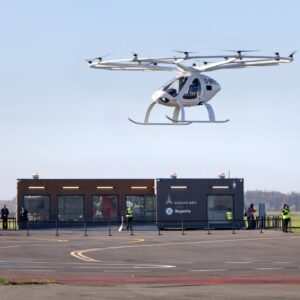
Skyports, a pioneering British drone manufacturer, is gearing up to launch Europe’s first air taxis in 2026. After securing a substantial $110 million in funding, the company is poised to revolutionize urban transportation with its electric vertical take-off and landing (eVTOL) aircraft. Skyports has already demonstrated the potential of eVTOLs through successful transport and surveillance tests. This significant financial boost brings the concept of commercial air taxis closer to becoming a reality for passenger transport.
The inaugural flights are scheduled to commence in the UAE. Earlier this year, Skyports inked a deal with Dubai authorities to initiate this groundbreaking service. The agreement includes the construction of four vertiports, specialized airports for VTOL taxis, set to be completed before the 2026 launch.
Following the UAE debut, Skyports plans to introduce air taxis to Europe. The company is currently developing the UK’s first vertiport test environment in Oxfordshire. In addition to its European ambitions, Skyports is collaborating with US port authorities on a drone-based logistics project designed to optimize the middle-mile segment between distribution centers and retail endpoints. The recent capital infusion is expected to accelerate these developments significantly.
The $110 million funding was part of a Series C capital round, with notable contributions from ACS Group, a Spanish infrastructure and construction giant, and Paris-based airport operator Groupe ADP. This investment positions Skyports at the forefront of the eVTOL market.
Duncan Walker, CEO and co-founder of Skyports, emphasized the company’s strengthened market position and future prospects. “With the support of ACS, we are in the best possible position to advance commercial air taxi and electric drone services worldwide,” Walker stated. He expressed confidence in using the funds to develop innovative air services.
eVTOL technology is garnering increasing interest due to its potential environmental benefits and operational efficiencies. These aircraft combine electric propulsion with vertical flight capabilities, offering a sustainable alternative to traditional transportation methods. They can reduce carbon emissions, operate in confined spaces, and eliminate the need for extensive runways.
However, the adoption of eVTOLs is not without its challenges. Critics argue that the technology is impractical and not cost-effective. Skyports aims to address these concerns by demonstrating the viability and value of air taxis, with a goal to commence operations by 2026.
Expanding Horizons and Future Prospects
The potential applications of eVTOLs extend beyond urban air taxis. Skyports is exploring various use cases, including emergency medical services, cargo transportation, and connecting remote areas. The flexibility and efficiency of eVTOLs make them suitable for a wide range of industries.
In the emergency services sector, eVTOLs can provide rapid response capabilities, delivering medical supplies or transporting patients to hospitals quickly. For cargo transportation, these aircraft can streamline logistics by providing faster and more direct routes, especially in congested urban environments.
Moreover, eVTOLs have the potential to connect remote and underserved regions, providing essential services and improving accessibility. This could have significant socio-economic benefits, enhancing connectivity and fostering economic development in isolated areas.
As the technology evolves, regulatory frameworks and infrastructure development will play a crucial role in the widespread adoption of eVTOLs. Skyports is actively engaging with regulatory bodies and stakeholders to address these challenges and ensure a smooth integration of air taxis into existing transportation systems.
The journey towards mainstream adoption of eVTOLs involves overcoming technical, regulatory, and public perception hurdles. However, with continuous advancements and increasing investments, the vision of a future where air taxis are a common sight in urban skies is becoming increasingly attainable. Skyports’ ambitious plans and strategic collaborations position it as a key player in shaping the future of urban air mobility.
Source: thenextweb.com
More articles you may be interested in...
Drones News & Articles
China’s automated logistics network exposes Western regulatory inertia
Drones News & Articles
The hovering sniper: China’s new rifle-drone achieves “deadly precision”
A recent report indicates that Chinese researchers have overcome one of the primary hurdles in robotic warfare: recoil management.
EVTOL & VTOL News & Articles
Sanghajt opens up to drones
From February, drones will be able to fly over designated areas without prior notification, with the local government seeing tremendous...>>>...READ MORE
Drones News & Articles
DJI agras series: a new era in autonomous agricultural robotics
Air taxi News & Articles
The great convergence: standardizing electric flight propulsion
EVTOL & VTOL News & Articles
The tethered sky: Navigating the integration of U-space and energy grids
News & Articles Propulsion-Fuel
Hydrogen’s regional mandate: Retrofitting the future of flight
EVTOL & VTOL News & Articles
Navigating the valley of reality: An AAM sector assessment
The Advanced Air Mobility (AAM) ecosystem has fundamentally shifted, transitioning from a period defined by...>>>...READ MORE
moreDrones News & Articles
Europe’s airspace awakens: The industrial reality of U-space 2.0
News & Articles Propulsion-Fuel
Hydrogen’s verdict: The 2026 propulsion shift redefining regional flight
News & Articles Propulsion-Fuel
Solid-state inflection: The 5-minute charge revolutionizing regional aviation
The nascent electric aviation sector currently faces a defining bottleneck that has less to do...>>>...READ MORE
EVTOL & VTOL News & Articles
The certification cascade: How Part 194 rewrites the rules of vertical flight
Drones News & Articles
Beyond Formula 1: engineering the 657 km/h Peregreen V4 drone record
In the realm of aerodynamics, the quadcopter configuration has traditionally been associated with stability and...>>>...READ MORE
moreEVTOL & VTOL News & Articles
EHang appoints Shuai Feng as chief technology officer
EHang Holdings Limited (Nasdaq: EH) (“EHang” or the “Company”), a global leader in advanced air mobility (“AAM”) technology, today officially announced that the Board of Directors of the Company (the “Board”) has approved and appointed Mr. Shuai Feng as the Chief Technology Officer (“CTO”), effective on January 14, 2026.