


A British drone manufacturer is taking a bold leap into the future of urban transportation. In just a few years, the skies over Europe could be buzzing with air taxis, offering an innovative solution to ease congestion on crowded city streets. Skyports, a leader in the field of urban air mobility, plans to launch its air taxi service in 2026 after successfully raising $110 million in funding. This move places Skyports at the forefront of an emerging market that is set to redefine how we think about urban travel.
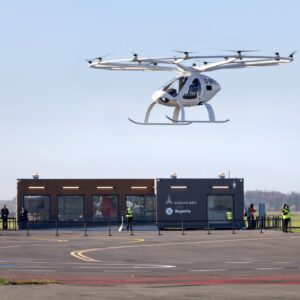
Skyports has already made significant strides, successfully testing electric vertical take-off and landing (eVTOL) aircraft in a range of applications, from transport to surveillance. With this substantial financial backing, the company is poised to accelerate its development efforts, making commercial air taxis a reality for the passenger transport market in Europe and beyond.
Skyports and the vision of urban air mobility
The concept of urban air mobility (UAM) is quickly gaining traction as cities worldwide grapple with increasing traffic congestion, air pollution, and inefficiencies in public transportation. Skyports, based in London, has emerged as one of the key players in this burgeoning industry. Leveraging advances in electric propulsion, the company is pioneering efforts to make short-range, on-demand air travel feasible and accessible.
The technology behind eVTOL aircraft represents a game-changer in the transport sector. Unlike traditional helicopters, eVTOLs are quieter, more energy-efficient, and can take off and land vertically with precision, making them ideally suited for crowded urban environments. Imagine gliding over a jam-packed street during rush hour or cutting your 60-minute drive down to a 10-minute flight that’s the promise of urban air taxis.
The UAE as a launch pad for air taxis
Skyports is set to make its first major commercial push in the United Arab Emirates (UAE). Earlier this year, Skyports inked a deal with the Dubai authorities to launch air taxis in the region, marking a major milestone for urban air travel. The company also announced the construction of four “vertiports” across Dubai small city airports designed specifically for VTOL (vertical take-off and landing) aircraft. These vertiports will enable seamless take-offs, landings, and charging operations for the air taxis.
Dubai, with its forward-thinking attitude and open embrace of technology, makes an ideal testing ground for air taxis. The city is well known for its futuristic skyline and commitment to smart infrastructure having previously pioneered autonomous vehicle tests, including self-driving taxis and shuttles. By launching in Dubai, Skyports hopes to prove the feasibility of air taxis in a controlled environment before bringing the service to more complex urban settings in Europe and the United States.
Bringing air taxis to Europe
Skyports aims to bring its air taxis to Europe after the initial success in the UAE. In preparation, the company is currently developing the UK’s first vertiport test environment in Oxfordshire. This location will be pivotal for testing the entire passenger experience from ticketing and boarding to flight operations and safety measures. The Oxfordshire site will also enable close collaboration with the UK’s Civil Aviation Authority (CAA) to meet rigorous safety and regulatory standards.
Additionally, Skyports is already working with the United States port authorities on a drone-based logistics project aimed at bridging the “middle mile” between distribution centers and retail endpoints. This could serve as a foundational step towards integrating VTOL aircraft in logistics and consumer mobility, further highlighting the diverse applications of this technology.
The role of investment in advancing air mobility
The recent $110 million funding round represents a major vote of confidence in Skyports’ vision. The capital injection includes a significant equity investment from ACS Group, a Spanish infrastructure and construction giant known for its forward-looking projects. Paris-based airport operator Groupe ADP has also contributed to the Series C funding, further cementing European interest in developing air taxi services.
The financial backing not only puts Skyports in a “market-leading position,” as stated by Duncan Walker, CEO and co-founder of Skyports, but also signals a growing confidence in urban air mobility as an economically viable and transformative solution for cities. Walker stressed that with the support of ACS, Skyports is now in “the best possible position” to advance both commercial air taxi services and electric drone logistics globally.
For more details about the stakeholders involved, visit ACS Group and Groupe ADP.
Potential benefits and challenges of air taxis
Benefits
The widespread adoption of air taxis could revolutionize urban transportation. Here are some potential benefits:
Reduced congestion: By utilizing the vertical dimension, air taxis can help alleviate road congestion in busy cities. This would be particularly valuable in urban centers like Paris, London, and New York, where traffic jams are a daily reality.
Sustainable mobility: Unlike conventional vehicles, eVTOLs are fully electric, which means they generate zero emissions at the point of use. As countries strive to meet their climate commitments, air taxis could play a significant role in reducing transportation-related emissions.
Time efficiency: Air taxis could cut down travel time drastically. For example, a trip from central London to Heathrow Airport could take just 15 minutes by air taxi, compared to over an hour by car during peak traffic times.
Challenges
While the potential benefits are enticing, there are several significant challenges that must be addressed:
Infrastructure requirements: Establishing vertiports in cities is a complex logistical challenge. Appropriate locations must be identified, and approvals from local governments need to be obtained.
Safety and regulation: Safety is paramount when it comes to transporting passengers through the skies. Extensive testing and regulatory approvals will be required to ensure that air taxis meet stringent safety standards.
Public perception and pricing: To gain widespread adoption, the public must be comfortable with the idea of air taxis. Moreover, initial costs are likely to be high, making this service a luxury option in the early years.
For more about the challenges of urban air mobility, Wikipedia provides a useful overview.
Building an air taxi infrastructure: vertiports
Skyports isn’t just developing aircraft; the company is also building the infrastructure needed to support this new mode of transport. Vertiports are small airports dedicated to VTOL aircraft, designed to handle passenger embarkation, refueling (or in this case, recharging), and maintenance of air taxis. A network of vertiports will be crucial for making urban air travel viable, providing a seamless experience for passengers and ensuring that eVTOLs can operate efficiently.
In Europe, the development of vertiports will require collaboration with city planners, construction firms, and local governments. The aim is to integrate these stations into the existing urban fabric without disrupting daily life. By placing vertiports at strategic locations—such as near major train stations or business hubs Skyports hopes to offer a seamless connection between different modes of transportation.
The future of air taxis: more than just passenger transport
Although much of the current focus is on passenger transport, Skyports and other companies in the urban air mobility sector are also exploring other potential uses for eVTOL technology. In the logistics industry, eVTOLs could be used for rapid cargo transport, bridging gaps between warehouses and distribution centers, especially in areas with poor road connectivity. In healthcare, air taxis could be utilized for emergency medical transport, delivering supplies or even medical personnel to hard-to-reach locations in a matter of minutes.
The flexibility of eVTOL aircraft, combined with advances in automation and artificial intelligence, suggests that urban air mobility could extend beyond city limits, helping improve logistics, supply chain efficiency, and emergency response capabilities on a much broader scale.
Skyports is helping to make the once futuristic dream of air taxis a reality. With a strong foundation of funding, a promising start in Dubai, and ongoing development in Europe and the United States, the company is well-positioned to redefine urban transportation as we know it. By integrating air taxis into our cities, Skyports aims to alleviate congestion, offer sustainable travel options, and ultimately transform the way we move. However, there are challenges to overcome, including regulatory hurdles, infrastructure development, and public acceptance.
The dream of quick, efficient, and sustainable urban flight is coming into focus. As the world watches Dubai’s skies in 2026, we may be witnessing the dawn of a new era in mobility one where the air taxi becomes a familiar sight, lifting passengers high above the traffic, offering a glimpse of a more efficient, connected future.
To stay informed about the latest in urban air mobility, check out Skyports’ official website: Skyports.
More articles you may be interested in...
Drones News & Articles
China’s automated logistics network exposes Western regulatory inertia
Drones News & Articles
The hovering sniper: China’s new rifle-drone achieves “deadly precision”
A recent report indicates that Chinese researchers have overcome one of the primary hurdles in robotic warfare: recoil management.
EVTOL & VTOL News & Articles
Sanghajt opens up to drones
From February, drones will be able to fly over designated areas without prior notification, with the local government seeing tremendous...>>>...READ MORE
Drones News & Articles
DJI agras series: a new era in autonomous agricultural robotics
Air taxi News & Articles
The great convergence: standardizing electric flight propulsion
EVTOL & VTOL News & Articles
The tethered sky: Navigating the integration of U-space and energy grids
News & Articles Propulsion-Fuel
Hydrogen’s regional mandate: Retrofitting the future of flight
EVTOL & VTOL News & Articles
Navigating the valley of reality: An AAM sector assessment
The Advanced Air Mobility (AAM) ecosystem has fundamentally shifted, transitioning from a period defined by...>>>...READ MORE
moreDrones News & Articles
Europe’s airspace awakens: The industrial reality of U-space 2.0
News & Articles Propulsion-Fuel
Hydrogen’s verdict: The 2026 propulsion shift redefining regional flight
News & Articles Propulsion-Fuel
Solid-state inflection: The 5-minute charge revolutionizing regional aviation
The nascent electric aviation sector currently faces a defining bottleneck that has less to do...>>>...READ MORE
EVTOL & VTOL News & Articles
The certification cascade: How Part 194 rewrites the rules of vertical flight
Drones News & Articles
Beyond Formula 1: engineering the 657 km/h Peregreen V4 drone record
In the realm of aerodynamics, the quadcopter configuration has traditionally been associated with stability and...>>>...READ MORE
moreEVTOL & VTOL News & Articles
EHang appoints Shuai Feng as chief technology officer
EHang Holdings Limited (Nasdaq: EH) (“EHang” or the “Company”), a global leader in advanced air mobility (“AAM”) technology, today officially announced that the Board of Directors of the Company (the “Board”) has approved and appointed Mr. Shuai Feng as the Chief Technology Officer (“CTO”), effective on January 14, 2026.