

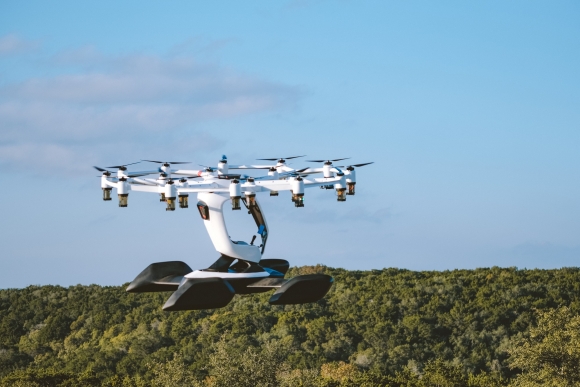
The American startup, Lift Aircraft, which cooperates with Hungarian engineers and designers, would offer an alternative to traffic jams and public transport with an ultralight drone carrying people. However, the age of air taxiing has not yet arrived: the obstacle is not technology but the lack of regulation. Balázs Kerülő, the company’s chief engineer, talked about the 22nd trap of the current legal situation and the business model, which may provide an answer to this.
Up to 10 minutes – that’s what Hexa “pilots” spend in the air. During this time, approx. They will cover 6-7 km, and the road, which is still part of the boot list program, will cost $ 200 (about HUF 62,000). No license is required to control the drone, and in case of trouble, the ground control center takes control of the vehicle.
From drone bikes to ultralight machines
Balázs Kerülő, a senior engineer at Texas-based Lift Aircraft, was originally trained as a pilot, but eventually did not stay in the profession. He wanted to create something more in the field of aviation that could then be used by others later, he says. He began working at a research institute and there he first encountered the statement that it was not possible to build a dragon larger than a certain size with more propellers because it would not survive in the air.
Of course, he believed the opposite, and he was one of the first in Hungary to deal with the design of electric, take-off and landing aircraft. The first concept was already operational, but it was not beautiful, then with the help of the Hungarian design company Maform, a drone bike called Flike was born, carrying a man.
Matthew Chasen, an American businessman, aeronautical engineer and hobby pilot, also noticed the project. He avoided Balázs Bypass and Maform to develop an ultralight, human-carrying drone under the auspices of Lift Aircraft.
The weight of the vehicle was a pivotal point because anyone in the United States can “drive” an aircraft below a certain weight limit without a license. “Currently, the situation of the No. 22 trap in the market of drone-based aircraft, which also takes off, is aggravating the situation,” says Balázs Kerülő. “If we want to do business with an aircraft, an official certification is required to obtain an airworthiness license. It takes a lot of hours flown to compile safety statistics, but these could only be shown with a flight permit. We’ve built an aircraft that fits into the ultralight category, so we have the potential to outperform companies that think in larger, more personal, longer-range aircraft ”.
The result was a single-person, structurally and electronically relatively simple flying device. Due to the weight limit, your battery isn’t big either, so there’s enough to charge for a 10-minute ride. By the way, the design was also attractive, in October 2019 the machine won the Big SEE, one of the most prestigious design grand prizes in the Southeast European region in the mobility category)
It’s not really the pilot
The essence of Lift Aircraft’s business model is that contractors pay $ 200 for a 10-minute flight, which they can perform under controlled conditions, but completely alone with this aircraft, Balázs Kerülő continues. Hexa will soon be touring major US cities, and the company’s website should be well in advance for anyone looking to try out the aircraft.
The biggest challenge for Lift Aircraft – and for anyone looking to make a difference in this business – is to bring passengers down in the event of a problem, the flight engineer continues. “A conventional plane can be sailed from any height if the engine stops in the air and there is also a chance for helicopters to land with a skillful pilot, the so-called in autorotation mode. This is less true for our category, multicopters. When the rotors stop, such a machine starts to fall uncontrollably because the pilot has no direct influence on the flight characteristics, the rotors are computer controlled, similar to the operation of a self-driving car ”.
From the ground it is possible to take control of Hexa. If the pilot becomes ill, or unable to contact him, or simply indicates that he is tired of the trip and wants to come home, the team can take control of the plane from the ground at the touch of a button. It is also possible to have more, so-called. a so-called geofence is used to delimit the airspace in which the aircraft can operate and the computer does not release the aircraft from a particular area. That is, it cannot happen that someone steps down with the drone: the plane will stop at the airspace boundary and wait for the new instruction.
The long-term plan is to have a version of Hexa that can once act as an air taxi. “By the time the regulation allows air taxi operators to operate, Hexa will already have thousands of hours of flight statistics and experience in another mode of use,” says Balázs Kerülő.
We still have to wait for air taxis
Even today, there are situations where someone needs to get from A to B as fast as possible. We always find people who have precious enough time for this, and there are emergencies where someone needs first aid, needs to put out a fire, a situation of persecution or disaster. But these uses are not the same as air taxis, because they are not yet significant means to get to our destination. According to Balázs Kerülő, this is even more in the perspective of a quarter of a century, or even 30-40 years, because ground transport is also developing, cars are getting smarter, and in the age of self-driving and communicating cars, traffic jams will be avoided in other ways. So ground transportation will always remain competitive with air travel and will likely remain much cheaper than air taxis.
“The technological conditions are already in place, but it is another question of when there will be a proper legal background, when there will be a proper transport culture, and when there will be confidence in such vehicles. In front of the first car, they even ran a red flag to keep people from getting scared. I think there will be a question of acceptance here too. We are working to set a good example, ”he adds.
More articles you may be interested in...
Drones News & Articles
China’s automated logistics network exposes Western regulatory inertia
Drones News & Articles
The hovering sniper: China’s new rifle-drone achieves “deadly precision”
A recent report indicates that Chinese researchers have overcome one of the primary hurdles in robotic warfare: recoil management.
EVTOL & VTOL News & Articles
Sanghajt opens up to drones
From February, drones will be able to fly over designated areas without prior notification, with the local government seeing tremendous...>>>...READ MORE
Drones News & Articles
DJI agras series: a new era in autonomous agricultural robotics
Air taxi News & Articles
The great convergence: standardizing electric flight propulsion
EVTOL & VTOL News & Articles
The tethered sky: Navigating the integration of U-space and energy grids
News & Articles Propulsion-Fuel
Hydrogen’s regional mandate: Retrofitting the future of flight
EVTOL & VTOL News & Articles
Navigating the valley of reality: An AAM sector assessment
The Advanced Air Mobility (AAM) ecosystem has fundamentally shifted, transitioning from a period defined by...>>>...READ MORE
moreDrones News & Articles
Europe’s airspace awakens: The industrial reality of U-space 2.0
News & Articles Propulsion-Fuel
Hydrogen’s verdict: The 2026 propulsion shift redefining regional flight
News & Articles Propulsion-Fuel
Solid-state inflection: The 5-minute charge revolutionizing regional aviation
The nascent electric aviation sector currently faces a defining bottleneck that has less to do...>>>...READ MORE
EVTOL & VTOL News & Articles
The certification cascade: How Part 194 rewrites the rules of vertical flight
Drones News & Articles
Beyond Formula 1: engineering the 657 km/h Peregreen V4 drone record
In the realm of aerodynamics, the quadcopter configuration has traditionally been associated with stability and...>>>...READ MORE
moreEVTOL & VTOL News & Articles
EHang appoints Shuai Feng as chief technology officer
EHang Holdings Limited (Nasdaq: EH) (“EHang” or the “Company”), a global leader in advanced air mobility (“AAM”) technology, today officially announced that the Board of Directors of the Company (the “Board”) has approved and appointed Mr. Shuai Feng as the Chief Technology Officer (“CTO”), effective on January 14, 2026.