


Flying cars, once a staple of science fiction, are rapidly transitioning from fantasy to reality. With advancements in technology and an increasing need for innovative transportation solutions, multiple companies worldwide are racing to develop these hybrid vehicles. Designed to revolutionize both ground and aerial travel, flying cars promise to offer unprecedented convenience and efficiency. Among the frontrunners is China’s Xpeng Motors, a major innovator leveraging its expertise through its dedicated division, Xpeng AeroHT.
Paving the way for flying cars
Flying cars represent a paradigm shift in personal and urban mobility. By merging the practicality of cars with the speed and adaptability of aircraft, these vehicles aim to address critical issues such as urban congestion, pollution, and inefficient intercity travel. Their potential lies not only in offering a new mode of transportation but also in reshaping how cities and infrastructure evolve to accommodate them.
Xpeng’s strategy focuses on developing user-centric, technologically advanced designs that comply with safety and regulatory frameworks. Key to their success is overcoming public skepticism, ensuring energy efficiency, and creating vehicles that integrate seamlessly into both air and road environments. With the backing of substantial investments and rapid innovation, flying cars are steadily moving from conceptual prototypes to viable products.
Xpeng’s leadership in innovation
Xpeng Motors, a leader in China’s electric vehicle market, has positioned itself at the forefront of flying car development through its AeroHT division. While commercially available models are still forthcoming, the company has already introduced multiple prototypes showcasing groundbreaking features. These modular designs enable seamless transitions between ground-based driving and aerial navigation, providing versatile solutions for densely populated urban areas.
The AeroHT division integrates state-of-the-art technologies such as lightweight composite materials for enhanced flight performance, energy-efficient propulsion systems, and artificial intelligence to support autonomous operation. These innovations underscore Xpeng’s commitment to pioneering the flying car industry while prioritizing sustainability and safety.
The land aircraft carrier: Xpeng’s flagship innovation
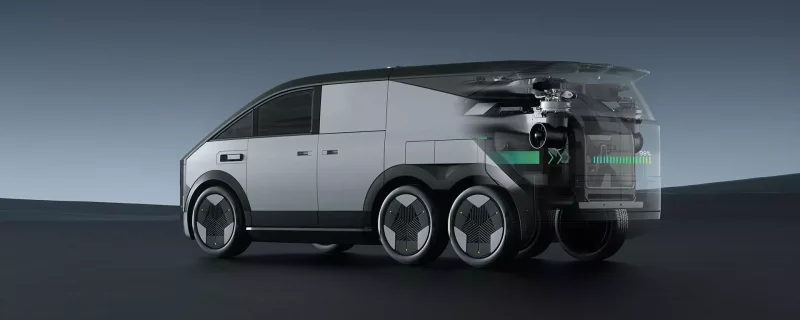
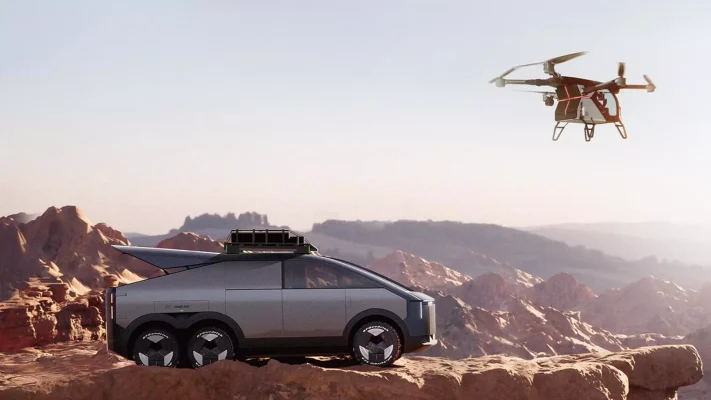
Xpeng’s most ambitious project, the Land Aircraft Carrier (LAC), is set to debut at CES 2025 in Las Vegas. This cutting-edge hybrid vehicle combines a six-wheeled electric car with a fully operational drone, demonstrating a bold step toward integrating ground and aerial travel.
Technical highlights
Measuring 5.5 meters in length, 2 meters in width, and 2 meters in height, the LAC embodies both functionality and innovation. It features a dual propulsion system: an electric drivetrain complemented by an internal combustion engine for range extension, enabling up to 1,000 kilometers of ground travel per refueling. This versatility makes it suitable for diverse environments and extended journeys.
The drone module, mounted at the rear, is equipped with six foldable rotors for efficient storage and reliable flight. Transitioning between car and drone modes is fully automated and takes only a few minutes. During this process, passengers transfer from the vehicle’s main cabin to the drone module, ensuring maximum safety and optimal aerodynamics during flight.
Enhanced with advanced navigation sensors, collision-avoidance technology, and AI-driven controls, the LAC’s design ensures precision and stability even in dense urban settings. Its sleek, aerodynamic structure minimizes drag, boosting energy efficiency and overall performance.
Redefining usability and performance
The LAC’s drone module operates on an 800-volt electric system, allowing rapid charging from 30% to 80% in just 18 minutes. This capability supports 5-6 short flights on a full charge, accommodating two passengers per trip. Users can opt for autonomous or manual flight modes, with the former offering convenient pre-programmed navigation to specific destinations.
Safety is paramount in the LAC’s design. Multiple redundancies, including backup power systems and deployable parachutes, provide robust protection in emergencies. The modular structure also facilitates easy maintenance and future upgrades, ensuring longevity and adaptability.
Market reception and potential
Interest in the LAC has surged, with over 2,000 pre-orders already placed in China. Public flight demonstrations have reinforced confidence in its capabilities, highlighting its practicality and performance. However, significant challenges remain, including regulatory compliance, infrastructure development, and the high production cost of 2 million yuan.
To address these barriers, Xpeng has initiated collaborations with urban planners to integrate flying cars into existing transportation networks. These partnerships aim to identify infrastructure needs, such as charging stations and vertiports, ensuring a smoother path to mainstream adoption.
Challenges on the horizon
Despite remarkable progress, flying cars face a series of complex challenges:
Regulatory adaptation: Governments must establish comprehensive guidelines for airspace management and pilot certification, as well as safety protocols, to accommodate flying vehicles.
Infrastructure investment: Cities need extensive upgrades, including charging stations, maintenance facilities, and dedicated takeoff and landing zones, to support widespread use.
Public trust and education: Building confidence in the safety and reliability of flying cars requires transparent testing, rigorous safety standards, and effective communication.
Xpeng plans to manufacture approximately 10,000 units annually, with scalability contingent on market demand. Advances in battery technology, lightweight materials, and AI navigation systems are expected to lower costs and improve accessibility over time. Partnerships with government agencies and private stakeholders will also play a critical role in overcoming logistical and regulatory hurdles.
Looking ahead: the promise of flying cars
The Land Aircraft Carrier showcases the transformative potential of flying cars to redefine transportation. While their widespread adoption may take years, the progress made by innovators like Xpeng Motors signals a pivotal shift toward a future where ground-to-air mobility becomes commonplace.
As the industry matures, flying cars offer viable solutions to pressing issues such as traffic congestion, pollution, and the demand for faster intercity travel. Though the road ahead is filled with challenges, the vision of seamless, efficient, and sustainable mobility continues to captivate both developers and consumers.
More articles you may be interested in...
Drones News & Articles
China’s automated logistics network exposes Western regulatory inertia
Drones News & Articles
The hovering sniper: China’s new rifle-drone achieves “deadly precision”
A recent report indicates that Chinese researchers have overcome one of the primary hurdles in robotic warfare: recoil management.
EVTOL & VTOL News & Articles
Sanghajt opens up to drones
From February, drones will be able to fly over designated areas without prior notification, with the local government seeing tremendous...>>>...READ MORE
Drones News & Articles
DJI agras series: a new era in autonomous agricultural robotics
Air taxi News & Articles
The great convergence: standardizing electric flight propulsion
EVTOL & VTOL News & Articles
The tethered sky: Navigating the integration of U-space and energy grids
News & Articles Propulsion-Fuel
Hydrogen’s regional mandate: Retrofitting the future of flight
EVTOL & VTOL News & Articles
Navigating the valley of reality: An AAM sector assessment
The Advanced Air Mobility (AAM) ecosystem has fundamentally shifted, transitioning from a period defined by...>>>...READ MORE
moreDrones News & Articles
Europe’s airspace awakens: The industrial reality of U-space 2.0
News & Articles Propulsion-Fuel
Hydrogen’s verdict: The 2026 propulsion shift redefining regional flight
News & Articles Propulsion-Fuel
Solid-state inflection: The 5-minute charge revolutionizing regional aviation
The nascent electric aviation sector currently faces a defining bottleneck that has less to do...>>>...READ MORE
EVTOL & VTOL News & Articles
The certification cascade: How Part 194 rewrites the rules of vertical flight
Drones News & Articles
Beyond Formula 1: engineering the 657 km/h Peregreen V4 drone record
In the realm of aerodynamics, the quadcopter configuration has traditionally been associated with stability and...>>>...READ MORE
moreEVTOL & VTOL News & Articles
EHang appoints Shuai Feng as chief technology officer
EHang Holdings Limited (Nasdaq: EH) (“EHang” or the “Company”), a global leader in advanced air mobility (“AAM”) technology, today officially announced that the Board of Directors of the Company (the “Board”) has approved and appointed Mr. Shuai Feng as the Chief Technology Officer (“CTO”), effective on January 14, 2026.