

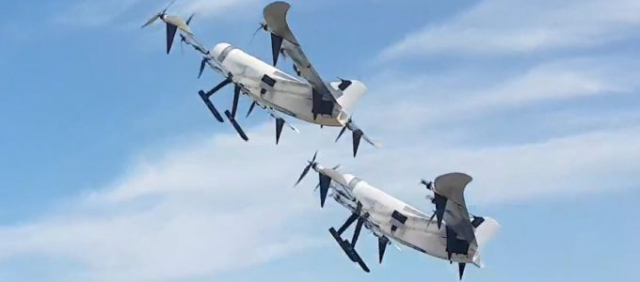
Researchers at Delft University of Technology have worked with the Royal Netherlands Navy (HNLMS) and the Coast Guard to develop an unmanned aircraft that is environmentally friendly, can take off vertically and stay in the air longer than any other current model of similar size. The built-in hydrogen fuel cells provide enough power for the 12 engines installed.
At the start of the drone, the electric motors are powered by onboard batteries, while in flight an 800-watt fuel cell takes care of this and recharges the excess power back into the batteries. The only substance emitted during the operation of the robotic aircraft is steam. The fuel cell is operated by a 6.8 liter hydrogen tank. The unmanned aircraft will remain operational even if some of its engines fail. It has a span of 3 meters and weighs 13 kilograms.
Although there are already drones with fuel cells, they cannot take off and land vertically and cannot fly over the sea or land for long periods of time. Bart Remes, of the Micro Air Vehicle Lab (MAVLab) and project manager at Delft University of Technology, also pointed out that the types involved are too slow to detect accidents or disasters.
The robotic aircraft was tested not only in a wind tunnel, but also with ships of the Royal Netherlands Navy and the Coast Guard. Pieter Blank, Innovation Commander of the Royal Netherlands Navy, said the hydrogen-powered unmanned aircraft is a real technical breakthrough and has great future potential.
More articles you may be interested in...
Drones News & Articles
China’s automated logistics network exposes Western regulatory inertia
Drones News & Articles
The hovering sniper: China’s new rifle-drone achieves “deadly precision”
A recent report indicates that Chinese researchers have overcome one of the primary hurdles in robotic warfare: recoil management.
EVTOL & VTOL News & Articles
Sanghajt opens up to drones
From February, drones will be able to fly over designated areas without prior notification, with the local government seeing tremendous...>>>...READ MORE
Drones News & Articles
DJI agras series: a new era in autonomous agricultural robotics
Air taxi News & Articles
The great convergence: standardizing electric flight propulsion
EVTOL & VTOL News & Articles
The tethered sky: Navigating the integration of U-space and energy grids
News & Articles Propulsion-Fuel
Hydrogen’s regional mandate: Retrofitting the future of flight
EVTOL & VTOL News & Articles
Navigating the valley of reality: An AAM sector assessment
The Advanced Air Mobility (AAM) ecosystem has fundamentally shifted, transitioning from a period defined by...>>>...READ MORE
moreDrones News & Articles
Europe’s airspace awakens: The industrial reality of U-space 2.0
News & Articles Propulsion-Fuel
Hydrogen’s verdict: The 2026 propulsion shift redefining regional flight
News & Articles Propulsion-Fuel
Solid-state inflection: The 5-minute charge revolutionizing regional aviation
The nascent electric aviation sector currently faces a defining bottleneck that has less to do...>>>...READ MORE
EVTOL & VTOL News & Articles
The certification cascade: How Part 194 rewrites the rules of vertical flight
Drones News & Articles
Beyond Formula 1: engineering the 657 km/h Peregreen V4 drone record
In the realm of aerodynamics, the quadcopter configuration has traditionally been associated with stability and...>>>...READ MORE
moreEVTOL & VTOL News & Articles
EHang appoints Shuai Feng as chief technology officer
EHang Holdings Limited (Nasdaq: EH) (“EHang” or the “Company”), a global leader in advanced air mobility (“AAM”) technology, today officially announced that the Board of Directors of the Company (the “Board”) has approved and appointed Mr. Shuai Feng as the Chief Technology Officer (“CTO”), effective on January 14, 2026.