

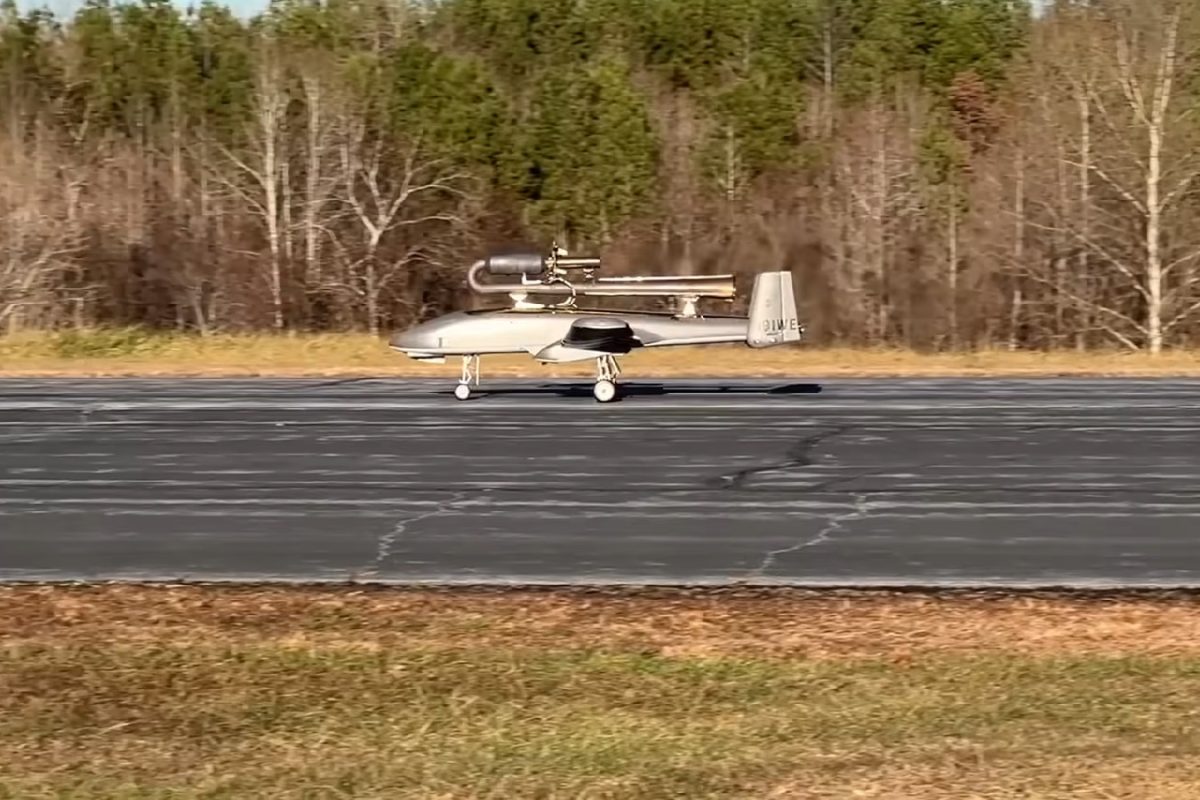
The jet engine without moving parts is not new, but it is too expensive to become widespread. But change could come, and one company is actively experimenting with it. When people think of a jet engine, most people think of the gas turbine version used on modern airliners. In this, the turbine, a rotating component, provides the thrust. But there are also systems that do not require a moving part: pulsating or pulsating jet engines.
Jet engines, as most envision them, are synonymous with the gas turbines seen on today’s airliners. These turbines, through their rotating components, generate the thrust that propels aircraft through the skies. However, nestled within the annals of aviation history lies an alternative propulsion method that eschews the need for moving parts entirely: the pulsating, or pulse jet, engine.
Pulse jet engines operate on a principle that harnesses resonance, wherein the expansion of combustion products exerts a force that propels the structure forward in a pulsating manner, characterized by the rhythmic intake and expulsion of fuel.
This technology, whose foundational patent dates back to 1905, is noted for its complexity and resultant costliness, which has largely confined its application to a niche status within the realm of jet propulsion. Nevertheless, American Wave Engine has emerged as a notable exception, championing the cause to rejuvenate this technology by making it both affordable and adaptable for broader uses.
A significant milestone in their quest was the development of a drone powered by a pulse jet engine, a feat achieved after years of meticulous design and construction. The drone, akin in appearance to military UAVs, tips the scales at 45 kilograms and is powered by the Wave Engine 222 N thrust engine.
Remarkably versatile, this engine is capable of operating on a variety of fuels, including petrol, kerosene, and bioethanol (E85), and boasts the ability to be remotely powered, as well as started or restarted mid-flight. This capability was rigorously tested, with the drone achieving speeds of up to 320 km/h— a limit imposed not by the engine itself, but by the constraints of the testing facility.
This exploration into pulse jet technology not only rekindles interest in a largely forgotten method of propulsion but also underscores a broader trend within the aviation industry towards innovation and diversification of energy sources. As the industry grapples with pressing environmental concerns and the quest for more efficient, sustainable forms of propulsion, the revisitation of pulse jet technology could herald a new era of aviation engineering.
The implications of this resurgence are profound, both immediately and in the longer term. In the near future, we may witness the integration of pulse jet engines into various aviation applications, from drones to potentially manned aircraft, offering benefits such as reduced mechanical complexity and enhanced fuel flexibility.
Looking further ahead, this revival could catalyze a broader shift in aviation, driving the exploration of alternative propulsion systems and fuel sources, and ultimately contributing to the sector’s environmental sustainability goals.
Moreover, the endeavors of companies like American Wave Engine signify a growing recognition of the value in revisiting and refining historical technologies to meet contemporary challenges. As the aviation industry continues to evolve, the fusion of old and new, tradition and innovation, may well define the next frontier of aerial exploration and transportation.
Source: Wave Engine Corp
More articles you may be interested in...
Drones News & Articles
China’s automated logistics network exposes Western regulatory inertia
Drones News & Articles
The hovering sniper: China’s new rifle-drone achieves “deadly precision”
A recent report indicates that Chinese researchers have overcome one of the primary hurdles in robotic warfare: recoil management.
EVTOL & VTOL News & Articles
Sanghajt opens up to drones
From February, drones will be able to fly over designated areas without prior notification, with the local government seeing tremendous...>>>...READ MORE
Drones News & Articles
DJI agras series: a new era in autonomous agricultural robotics
Air taxi News & Articles
The great convergence: standardizing electric flight propulsion
EVTOL & VTOL News & Articles
The tethered sky: Navigating the integration of U-space and energy grids
News & Articles Propulsion-Fuel
Hydrogen’s regional mandate: Retrofitting the future of flight
EVTOL & VTOL News & Articles
Navigating the valley of reality: An AAM sector assessment
The Advanced Air Mobility (AAM) ecosystem has fundamentally shifted, transitioning from a period defined by...>>>...READ MORE
moreDrones News & Articles
Europe’s airspace awakens: The industrial reality of U-space 2.0
News & Articles Propulsion-Fuel
Hydrogen’s verdict: The 2026 propulsion shift redefining regional flight
News & Articles Propulsion-Fuel
Solid-state inflection: The 5-minute charge revolutionizing regional aviation
The nascent electric aviation sector currently faces a defining bottleneck that has less to do...>>>...READ MORE
EVTOL & VTOL News & Articles
The certification cascade: How Part 194 rewrites the rules of vertical flight
Drones News & Articles
Beyond Formula 1: engineering the 657 km/h Peregreen V4 drone record
In the realm of aerodynamics, the quadcopter configuration has traditionally been associated with stability and...>>>...READ MORE
moreEVTOL & VTOL News & Articles
EHang appoints Shuai Feng as chief technology officer
EHang Holdings Limited (Nasdaq: EH) (“EHang” or the “Company”), a global leader in advanced air mobility (“AAM”) technology, today officially announced that the Board of Directors of the Company (the “Board”) has approved and appointed Mr. Shuai Feng as the Chief Technology Officer (“CTO”), effective on January 14, 2026.