


Alef Aeronautics, a California-based innovator in sustainable transportation, is redefining urban mobility with its electric vertical takeoff and landing (eVTOL) vehicle, the Model A. Designed to function as both a road-legal car and an aircraft, this dual-mode vehicle integrates automotive and aviation technologies to address modern congestion challenges. Priced at approximately $300,000, the Model A has garnered significant interest, with over 3,300 pre-orders, signaling strong market demand for advanced air mobility (AAM) solutions.
Design and functionality
The Model A, Alef Aeronautics’ flagship eVTOL, is engineered to operate seamlessly on roads and in the air. Unlike traditional aircraft, it resembles a conventional car in appearance, adhering to standard road dimensions for parking and driving. Its lightweight carbon-fiber body houses eight electric rotors four at the front and four at the rear enabling vertical takeoff and landing without the need for runways or dedicated vertiports.
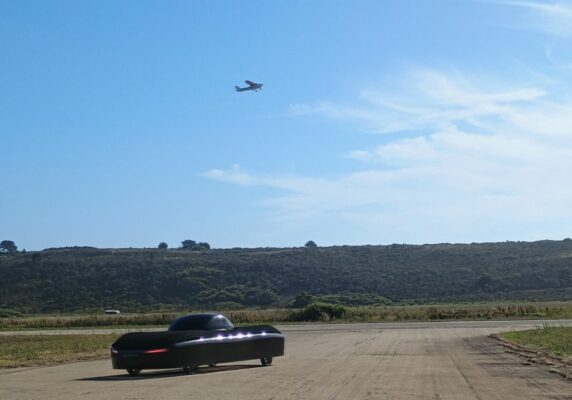
During flight, the vehicle transitions into a biplane configuration by rotating 90 degrees, with the sides of the car serving as upper and lower wings. A gimbaled cockpit ensures passenger stability, maintaining an upright position regardless of the vehicle’s orientation.
Critical insight: The Model A’s dual-mode design is a significant departure from other eVTOLs, such as those developed by Joby Aviation or Archer Aviation, which prioritize air-only operations. By integrating road drivability, Alef addresses a critical gap in urban mobility, allowing users to navigate traffic-congested areas by “hopping” over obstacles. However, the transition mechanism’s complexity raises questions about long-term reliability and maintenance costs, which Alef must address to ensure consumer confidence.
The vehicle boasts a driving range of 200 miles and a flight range of 110 miles, powered by a fully electric distributed propulsion system. This system, combined with a mesh-like exterior, conceals the rotors for enhanced safety and aesthetics, reducing the risk of debris interference during takeoff. Alef claims the Model A consumes less energy per trip than conventional electric vehicles, positioning it as an environmentally sustainable alternative for short-range commuting.
Professional observation: While the energy efficiency claim is promising, it requires rigorous third-party validation to compare against established EVs like Tesla’s Model 3. The limited flight range of 110 miles may restrict its utility for longer journeys, suggesting that Alef’s primary value proposition lies in short, urban “hops” rather than regional travel.
Did you know?
Contextual facts on roadable eVTOLs and advanced air mobility
- The idea predates today’s startups.The Taylor Aerocar, a roadable airplane, received U.S. civil certification in 1956; only six were built, underscoring how persistent—and challenging—dual-mode designs have been.
- Dedicated eVTOL rules exist.Europe published the first eVTOL-specific certification basis (EASA SC-VTOL) in 2019; its Means of Compliance continue to evolve as technology matures.
- Vertiports already have guidance.The FAA’s Engineering Brief 105 (2022, updated as 105A in 2024) provides interim standards for vertiport touchdown areas, safety buffers, and lighting until full regulations are adopted.
- A global certification first.In October 2023, China’s aviation authority issued the world’s first type certificate for a passenger-carrying eVTOL (EHang EH216-S), setting an international precedent for AAM.
- Noise matters more than you think.As a psychoacoustic rule-of-thumb, a 10 dB reduction is perceived as roughly half as loud—one reason urban eVTOL concepts prioritize low-noise operations versus helicopters.
- Energy density is the range gatekeeper.State-of-the-art lithium-ion cells typically provide ~250–300 Wh/kg at cell level; incremental gains translate directly into meaningful range increases for eVTOL missions.
- Redundancy is not optional.Distributed Electric Propulsion enables controlled flight or safe landing after certain motor failures when properly engineered—central to modern eVTOL safety cases.
- Dual-mode = more trade-offs.Designing for both road and air imposes packaging, weight, and maintenance compromises compared with air-only eVTOLs—historically the bottleneck for roadable aircraft.
Testing and integration into air transport infrastructure
Alef Aeronautics has secured agreements to conduct flight testing at Half Moon Bay Airport (KHAF) and Hollister Municipal Airport (KCVH) in California, marking a pivotal step toward integrating eVTOLs into existing aviation infrastructure. Testing began with the Model Zero Ultralight, a prototype designed for research and development, with plans to transition to the commercial Model A. These tests, initiated in August 2025, focus on vertical takeoff, forward flight, vertical landing, and ground maneuvering, ensuring compatibility with non-towered airport environments.
Critical insight: Operating in controlled, non-towered airports minimizes disruption to conventional air traffic, providing a safe testing ground. However, scaling eVTOL operations to urban environments will require robust air traffic management systems, such as “sky lanes,” to prevent conflicts with other aircraft. Alef’s collaboration with the Federal Aviation Administration (FAA) and airport operators is a proactive step, but the lack of established AAM regulations poses a significant hurdle.
The Model Zero’s first public flight demonstration occurred on February 19, 2025, showcasing its ability to lift off vertically from a public street and clear a parked vehicle. This milestone, verified by Alef’s CEO Jim Dukhovny, underscores the vehicle’s potential to operate in diverse environments. However, the ultralight classification imposes restrictions, such as daylight-only flights and prohibitions over densely populated areas, limiting its immediate practicality.
Professional observation: The public demonstration is a landmark achievement, akin to early aviation milestones, but the absence of audio in released footage raises questions about noise levels a critical factor for urban acceptance. Future tests must prioritize transparency regarding environmental impacts, including noise and debris generation, to address community concerns.
Safety and technological innovations
Safety is a cornerstone of Alef’s design philosophy, with the Model A incorporating triple to octuple redundancy in critical components, including its distributed electric propulsion (DEP) system. DEP ensures that if one or more rotors fail, the remaining units can safely land the vehicle. Additional safety features include a ballistic parachute, real-time diagnostics, and an artificial intelligence-based obstacle detection and avoidance system, enhancing situational awareness during flight.
Critical insight: The integration of AI-driven safety systems aligns with advancements in autonomous vehicle technology, potentially reducing pilot error. However, the reliance on AI raises concerns about cybersecurity and system reliability in adverse conditions, such as poor weather or GPS interference. Alef must demonstrate robust testing protocols to mitigate these risks.
The Model A’s gimbaled cockpit and elevon stabilization system provide precise control during flight transitions, ensuring a smooth experience for passengers. The vehicle’s compliance with the FAA’s Special Airworthiness Certificate, granted in June 2023, validates its safety for limited research and development flights, a significant milestone for a roadable aircraft.
Professional observation: The ballistic parachute is a pragmatic safety feature, offering a failsafe in emergency scenarios. However, its effectiveness in urban environments, where landing zones may be constrained, remains untested. Alef’s focus on redundancy is commendable, but public perception of safety will hinge on transparent crash-test data and real-world performance metrics.
Challenges and future prospects
Despite its innovative design, the Model A faces practical limitations. Classified as a low-speed vehicle (LSV), it is restricted to a maximum road speed of 25 mph, which may deter consumers expecting a fully functional car. The $300,000 price tag further limits its accessibility, though Alef plans to address this with the Model Z, a four-passenger eVTOL projected for 2035 at a more affordable $35,000. The Model Z aims to offer a 400-mile driving range, a 200-mile flight range, and autonomous flight capabilities, potentially broadening its market appeal.
Critical insight: The LSV classification, while enabling easier road certification, significantly undermines the Model A’s utility as a car. Consumers may find the speed restriction impractical for everyday use, particularly in highway-heavy regions like California. The Model Z’s ambitious price point and timeline suggest optimism, but scaling production to achieve such affordability will require substantial investment and technological breakthroughs.
Alef’s vision of “hop” commuting driving where traffic flows freely and flying over congestion relies on infrastructure adaptations, including designated takeoff and landing zones. The company’s partnerships with PUCARA Aero and MYC for industry-grade components signal a commitment to scalability, but widespread adoption will depend on regulatory evolution and public acceptance.
Professional observation: Alef’s focus on integrating automotive and aviation infrastructures is forward-thinking, but the lack of urban air traffic management systems remains a bottleneck. Collaboration with regulators and municipalities will be critical to establishing viable operational frameworks, particularly for managing noise and ensuring equitable access to AAM.
Reimagine urban transportation
Alef Aeronautics’ Model A represents a bold step toward realizing the science fiction-inspired dream of a flying car. Its dual-mode functionality, advanced safety features, and ongoing testing at California airports position it as a pioneer in advanced air mobility. However, challenges such as regulatory hurdles, speed limitations, and high costs underscore the need for continued innovation and infrastructure development. As Alef refines its technology and navigates the complexities of air and ground integration, the Model A could redefine urban transportation, offering a glimpse into a future where commuting transcends traditional boundaries.
References:
More articles you may be interested in...
Drones News & Articles
China’s automated logistics network exposes Western regulatory inertia
Drones News & Articles
The hovering sniper: China’s new rifle-drone achieves “deadly precision”
A recent report indicates that Chinese researchers have overcome one of the primary hurdles in robotic warfare: recoil management.
EVTOL & VTOL News & Articles
Sanghajt opens up to drones
From February, drones will be able to fly over designated areas without prior notification, with the local government seeing tremendous...>>>...READ MORE
Drones News & Articles
DJI agras series: a new era in autonomous agricultural robotics
Air taxi News & Articles
The great convergence: standardizing electric flight propulsion
EVTOL & VTOL News & Articles
The tethered sky: Navigating the integration of U-space and energy grids
News & Articles Propulsion-Fuel
Hydrogen’s regional mandate: Retrofitting the future of flight
EVTOL & VTOL News & Articles
Navigating the valley of reality: An AAM sector assessment
The Advanced Air Mobility (AAM) ecosystem has fundamentally shifted, transitioning from a period defined by...>>>...READ MORE
moreDrones News & Articles
Europe’s airspace awakens: The industrial reality of U-space 2.0
News & Articles Propulsion-Fuel
Hydrogen’s verdict: The 2026 propulsion shift redefining regional flight
News & Articles Propulsion-Fuel
Solid-state inflection: The 5-minute charge revolutionizing regional aviation
The nascent electric aviation sector currently faces a defining bottleneck that has less to do...>>>...READ MORE
EVTOL & VTOL News & Articles
The certification cascade: How Part 194 rewrites the rules of vertical flight
Drones News & Articles
Beyond Formula 1: engineering the 657 km/h Peregreen V4 drone record
In the realm of aerodynamics, the quadcopter configuration has traditionally been associated with stability and...>>>...READ MORE
moreEVTOL & VTOL News & Articles
EHang appoints Shuai Feng as chief technology officer
EHang Holdings Limited (Nasdaq: EH) (“EHang” or the “Company”), a global leader in advanced air mobility (“AAM”) technology, today officially announced that the Board of Directors of the Company (the “Board”) has approved and appointed Mr. Shuai Feng as the Chief Technology Officer (“CTO”), effective on January 14, 2026.