


Honda, renowned for its groundbreaking advancements in automotive engineering, has once again demonstrated its ability to redefine mobility with the development of its eVTOL (electric Vertical Take-Off and Landing) aircraft. This innovative venture underscores Honda’s commitment to sustainable transportation solutions and marks its strategic foray into the rapidly expanding field of urban air mobility (UAM).
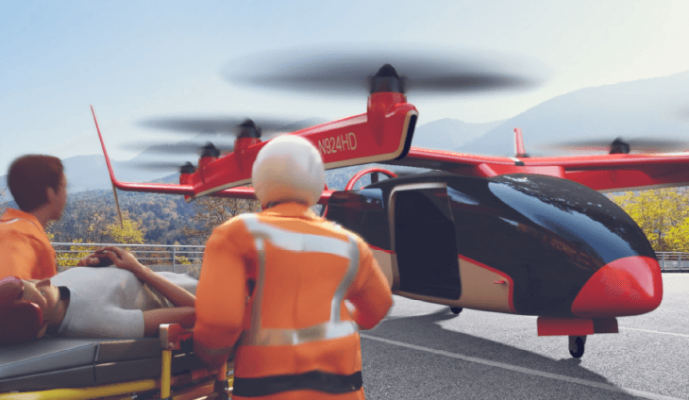
A leap into the future of mobility
The Honda eVTOL exemplifies the company’s innovative spirit. Designed to address the challenges of urban congestion, the eVTOL offers an efficient, environmentally friendly alternative to traditional ground-based transportation. By integrating electric propulsion with vertical take-off and landing capabilities, Honda aims to enable faster, cleaner, and more convenient travel in densely populated areas.
Why eVTOLs matter
Urban air mobility solutions are gaining traction globally as cities face increasing traffic congestion, environmental challenges, and the need for more efficient transport systems. According to a report by MarketsandMarkets, the global UAM market is projected to grow from $2.6 billion in 2022 to $9.1 billion by 2030, with eVTOLs playing a pivotal role in this expansion. Honda’s entry into this market reflects its commitment to addressing these pressing issues through technological innovation.
Key features of the Honda eVTOL
Honda’s eVTOL stands out due to its cutting-edge design and advanced features, which include:
Hybrid-electric propulsion system: Unlike fully electric competitors, Honda’s eVTOL incorporates a hybrid system, combining battery power with a gas turbine engine. This approach extends the aircraft’s range, making it suitable for inter-city travel in addition to urban commuting.
Quiet operation: Noise reduction is a critical factor for urban deployment. Honda’s engineers have leveraged their expertise in aerodynamics and propulsion technology to develop a quiet, community-friendly aircraft.
Safety and redundancy: Honda’s eVTOL includes multiple safety features, such as redundant systems for propulsion and control, ensuring reliability even in challenging conditions.
Applications and potential impact
The versatility of eVTOL technology enables it to serve various applications, including passenger transport, emergency medical services, and logistics. Honda’s focus on hybrid-electric propulsion positions its eVTOL as a practical solution for a broad range of use cases.
Case study: UAM in practice
Cities like Los Angeles and Singapore are already exploring UAM solutions. For instance, Singapore’s Civil Aviation Authority has partnered with Volocopter to test eVTOL operations. Honda’s entry into this space could accelerate the adoption of similar solutions worldwide, particularly in regions where reliable urban transport is a critical need.
Challenges and future outlook
While the potential of eVTOL technology is immense, several challenges must be addressed:
Infrastructure development: Establishing vertiports (landing and take-off hubs) and integrating eVTOLs into existing air traffic control systems are significant hurdles.
Regulatory approval: Certification from aviation authorities such as the FAA and EASA requires rigorous testing and validation.
Public acceptance: Ensuring safety and demonstrating the benefits of eVTOLs will be key to gaining public trust.
Honda’s extensive experience in engineering and manufacturing positions it well to overcome these challenges. By collaborating with government agencies, infrastructure developers, and other stakeholders, Honda aims to bring its eVTOL to market within the next decade.
The Honda eVTOL represents a bold step into the future of transportation. By leveraging its expertise in automotive and aerospace technologies, Honda is poised to make a significant impact on urban air mobility. As cities continue to grapple with congestion and environmental concerns, innovations like the Honda eVTOL offer a glimpse of a cleaner, faster, and more connected future.
More articles you may be interested in...
Drones News & Articles
China’s automated logistics network exposes Western regulatory inertia
Drones News & Articles
The hovering sniper: China’s new rifle-drone achieves “deadly precision”
A recent report indicates that Chinese researchers have overcome one of the primary hurdles in robotic warfare: recoil management.
EVTOL & VTOL News & Articles
Sanghajt opens up to drones
From February, drones will be able to fly over designated areas without prior notification, with the local government seeing tremendous...>>>...READ MORE
Drones News & Articles
DJI agras series: a new era in autonomous agricultural robotics
Air taxi News & Articles
The great convergence: standardizing electric flight propulsion
EVTOL & VTOL News & Articles
The tethered sky: Navigating the integration of U-space and energy grids
News & Articles Propulsion-Fuel
Hydrogen’s regional mandate: Retrofitting the future of flight
EVTOL & VTOL News & Articles
Navigating the valley of reality: An AAM sector assessment
The Advanced Air Mobility (AAM) ecosystem has fundamentally shifted, transitioning from a period defined by...>>>...READ MORE
moreDrones News & Articles
Europe’s airspace awakens: The industrial reality of U-space 2.0
News & Articles Propulsion-Fuel
Hydrogen’s verdict: The 2026 propulsion shift redefining regional flight
News & Articles Propulsion-Fuel
Solid-state inflection: The 5-minute charge revolutionizing regional aviation
The nascent electric aviation sector currently faces a defining bottleneck that has less to do...>>>...READ MORE
EVTOL & VTOL News & Articles
The certification cascade: How Part 194 rewrites the rules of vertical flight
Drones News & Articles
Beyond Formula 1: engineering the 657 km/h Peregreen V4 drone record
In the realm of aerodynamics, the quadcopter configuration has traditionally been associated with stability and...>>>...READ MORE
moreEVTOL & VTOL News & Articles
EHang appoints Shuai Feng as chief technology officer
EHang Holdings Limited (Nasdaq: EH) (“EHang” or the “Company”), a global leader in advanced air mobility (“AAM”) technology, today officially announced that the Board of Directors of the Company (the “Board”) has approved and appointed Mr. Shuai Feng as the Chief Technology Officer (“CTO”), effective on January 14, 2026.