


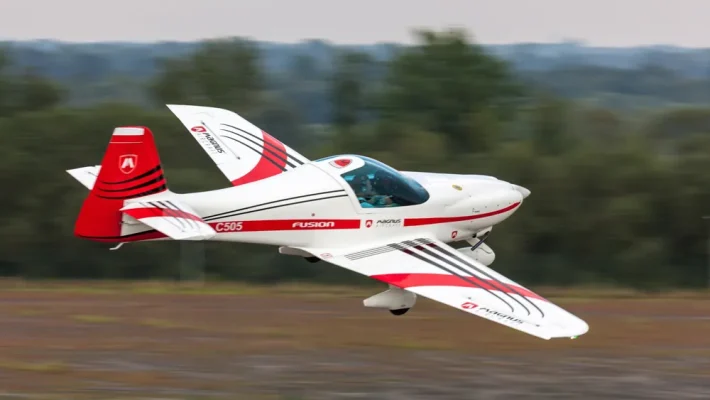
The Hungarian aircraft manufacturer, Magnus Aircraft Zrt., is gearing up to commence production of its small electric aircraft in China. Construction of their factory in Wuxi, located near Shanghai, is set to be completed by October. This marks a significant step for the company as it extends its reach beyond Hungary, leveraging Chinese state investment to build a new industrial park spanning 210,000 square meters. The facility will include a showroom, composite manufacturing, aircraft assembly, maintenance facilities, and a development center in collaboration with the University of Óbuda.
Target Markets and Employment
Magnus Aircraft aims to cater to markets in China, Iran, and Africa. The new venture, Jiangsu Magnus Aircraft Manufacturing, is projected to create 300 jobs, with significant roles designated for Hungarian employees. Once operational, the facility plans to produce thousands of two-seater aircraft and at least 400 four-seater models over the next decade.
International Presence and Future Prospects
In addition to its expansion in China, Magnus Aircraft has a growing international presence. The company is set to export aircraft to African nations, including Libya, Kenya, and Tanzania. They have also made notable sales in Europe, Asia, and the United States. The company’s current operations in Hungary employ 80 people, with plans to increase the workforce to 140 as production scales up at their Pogány site.
Electric Aircraft Development and Environmental Impact
The development of electric aircraft by Magnus is part of a broader trend towards sustainable aviation. Their aircraft, such as the Fusion 213, are designed to be environmentally friendly and technologically advanced, offering improved fuel efficiency and reduced emissions. This aligns with global efforts to combat climate change by reducing the carbon footprint of the aviation industry.
Historical Context and Technological Innovation
Hungary has a rich history in aeronautics and engineering. Magnus Aircraft’s advancements in electric aviation reflect the country’s longstanding expertise in these fields. The company’s initiatives contribute to Hungary’s position as a significant player in modern aerospace technology, particularly in the burgeoning market for electric aircraft.
Future Trends and Implications
Looking ahead, the production of electric aircraft in China by a Hungarian company highlights the increasing globalization of the aerospace industry. It signifies a shift towards more collaborative international efforts in manufacturing and technology development. This move could pave the way for further innovations and expansions in the electric aircraft market, potentially leading to new job creation, advancements in green technology, and a stronger emphasis on sustainable practices within the aviation sector.
The immediate implications of this expansion include job creation and economic growth in both Hungary and China. In the longer term, it could lead to increased adoption of electric aircraft globally, fostering a more sustainable aviation industry. Additionally, the collaboration between Hungarian and Chinese entities may serve as a model for future international partnerships in technology and manufacturing.
Magnus Aircraft’s venture into the Chinese market represents a significant milestone in the company’s growth and the broader push towards sustainable aviation. With the ongoing construction of their new facility in Wuxi and the planned production of electric aircraft, Magnus is poised to make a substantial impact on the aviation industry, both environmentally and economically. The company’s commitment to innovation and international collaboration underscores the potential for future advancements and the ongoing evolution of global aerospace technologies.
Source: HVG
More articles you may be interested in...
Drones News & Articles
China’s automated logistics network exposes Western regulatory inertia
Drones News & Articles
The hovering sniper: China’s new rifle-drone achieves “deadly precision”
A recent report indicates that Chinese researchers have overcome one of the primary hurdles in robotic warfare: recoil management.
EVTOL & VTOL News & Articles
Sanghajt opens up to drones
From February, drones will be able to fly over designated areas without prior notification, with the local government seeing tremendous...>>>...READ MORE
Drones News & Articles
DJI agras series: a new era in autonomous agricultural robotics
Air taxi News & Articles
The great convergence: standardizing electric flight propulsion
EVTOL & VTOL News & Articles
The tethered sky: Navigating the integration of U-space and energy grids
News & Articles Propulsion-Fuel
Hydrogen’s regional mandate: Retrofitting the future of flight
EVTOL & VTOL News & Articles
Navigating the valley of reality: An AAM sector assessment
The Advanced Air Mobility (AAM) ecosystem has fundamentally shifted, transitioning from a period defined by...>>>...READ MORE
moreDrones News & Articles
Europe’s airspace awakens: The industrial reality of U-space 2.0
News & Articles Propulsion-Fuel
Hydrogen’s verdict: The 2026 propulsion shift redefining regional flight
News & Articles Propulsion-Fuel
Solid-state inflection: The 5-minute charge revolutionizing regional aviation
The nascent electric aviation sector currently faces a defining bottleneck that has less to do...>>>...READ MORE
EVTOL & VTOL News & Articles
The certification cascade: How Part 194 rewrites the rules of vertical flight
Drones News & Articles
Beyond Formula 1: engineering the 657 km/h Peregreen V4 drone record
In the realm of aerodynamics, the quadcopter configuration has traditionally been associated with stability and...>>>...READ MORE
moreEVTOL & VTOL News & Articles
EHang appoints Shuai Feng as chief technology officer
EHang Holdings Limited (Nasdaq: EH) (“EHang” or the “Company”), a global leader in advanced air mobility (“AAM”) technology, today officially announced that the Board of Directors of the Company (the “Board”) has approved and appointed Mr. Shuai Feng as the Chief Technology Officer (“CTO”), effective on January 14, 2026.