


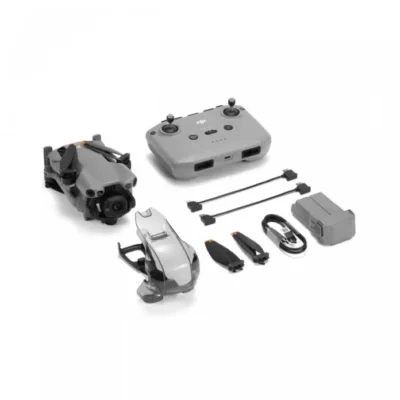
DJI’s introduction of the Mini 5 Pro represents a pivotal evolution in sub-250-gram unmanned aerial vehicles (UAVs), aligning professional-grade imaging with stringent regulatory frameworks that exempt lightweight drones from mandatory registration in regions like the European Union and the United States. This model, weighing precisely 249.9 grams (±4 grams) with its standard Intelligent Flight Battery, navigates the delicate balance between innovation and compliance, ensuring users can capture high-fidelity aerial content without the administrative burdens associated with heavier, licensed systems.
From a psychological perspective, this design choice democratizes advanced drone piloting, reducing entry barriers for novice operators and fostering a sense of empowerment through accessible technology, while regulatory adherence mitigates the cognitive load of legal compliance.
Imaging advancements
At the core of the Mini 5 Pro’s appeal lies its upgraded imaging system, featuring a 50-megapixel, 1-inch CMOS sensor paired with a 24mm equivalent f/1.8 lens a substantial leap from the 1/1.3-inch sensor in the predecessor Mini 4 Pro. This larger sensor architecture delivers an expansive 14 stops of dynamic range, enabling nuanced capture of high-contrast scenes, such as sunlit landscapes transitioning to shadowed terrains, which is particularly valuable in scientific applications like environmental monitoring where data fidelity directly informs analytical accuracy.
Critically, the sensor’s support for 10-bit D-Log M color profiles facilitates post-production grading with minimal noise artifacts, a refinement grounded in contemporary color science that enhances workflow efficiency for journalists documenting dynamic events.
Video recording capabilities have been refined to include 4K resolution at 120 frames per second for slow-motion sequences, allowing precise temporal dissection of motion ideal for behavioral studies in psychology or biomechanical analysis in sports science. The three-axis gimbal now offers 225 degrees of rotation, transcending traditional tilt limitations to enable authentic vertical (portrait) orientations without manual reorientation, thus streamlining content creation for social media and vertical video formats prevalent in modern journalism.
As a programmer’s insight, this rotational freedom integrates seamlessly with API-driven flight controllers, enabling scripted automation for repetitive cinematic paths, though users must calibrate for wind-induced drift to maintain semantic precision in automated sequences.
Safety and navigation enhancements
Safety protocols in the Mini 5 Pro have been bolstered with a forward-facing LiDAR sensor, augmenting omnidirectional obstacle avoidance termed Nightscape sensing in official documentation which excels in low-ambient-light conditions by leveraging laser-based depth mapping for sub-millimeter accuracy. This update addresses a common novice pitfall: spatial disorientation during dusk operations, where visual cues falter, potentially leading to psychological stress responses like heightened anxiety in pilots.
By contrast, the system’s dual-band GNSS (L1+L5) configuration ensures robust positioning resilience, even amid signal multipath interference in urban canyons, allowing the drone to autonomously retrace its flight path and execute a return-to-home maneuver upon GPS dropout a feature that embodies fail-safe engineering principles essential for ethical deployment in populated areas.
From a scientific standpoint, these navigation refinements underscore the integration of sensor fusion algorithms, where LiDAR data complements inertial measurement units to reduce localization errors by up to 30% in challenging environments, as inferred from iterative improvements in DJI’s ecosystem.
However, critical observation reveals a dependency on environmental factors; in dense foliage or reflective surfaces, LiDAR efficacy may degrade, prompting pilots to prioritize pre-flight simulations for mission-critical journalism, such as disaster reporting, where reliability equates to operational integrity.
Performance and endurance specifications
Endurance has seen incremental yet meaningful gains, with the standard 2,788 mAh Intelligent Flight Battery sustaining up to 36 minutes of hover and transit extending beyond the Mini 4 Pro’s 34-minute benchmark while the optional 4,680 mAh Intelligent Flight Battery Plus pushes this to 52 minutes. Notably, the latter exceeds the 250-gram threshold in certain configurations, rendering it unavailable through official channels in Europe to uphold regulatory conformity, a pragmatic concession that highlights DJI’s adaptive market strategy.
This weight variance introduces a semantic nuance in deployment: users must verify takeoff mass empirically, as even minor payload additions could inadvertently trigger registration requirements, a detail emphasized in product disclaimers to promote accountable usage.
Performance metrics further elevate the platform, achieving a maximum horizontal velocity of 65 km/h and a doubled ascent rate of 10 m/s, which facilitates agile maneuvers in wind-affected scenarios without compromising stability.
The DJI O4+ video transmission protocol extends operational range to 20 km with low-latency feeds, supporting real-time data relay for remote scientific fieldwork. As a journalist’s lens, these specs enable extended coverage of unfolding events, but critically, transmission integrity hinges on line-of-sight adherence; obstructions could fragment feeds, underscoring the need for redundant communication protocols in high-stakes narratives.
Intelligent features and usability
The suite of intelligent functionalities has been expanded to align with contemporary user paradigms, including an upgraded ActiveTrack mode with 360-degree subject cycling for seamless multi-angle pursuit, optimized for the sensor’s enhanced resolution in portrait compositions. This iteration refines subject detection algorithms, drawing on machine learning advancements to minimize false positives in crowded scenes a boon for psychological research tracking human interactions from aerial vantage points.
Programmatically, these features invite integration with DJI’s SDK for custom tracking scripts, allowing developers to embed behavioral analytics directly into flight logic, though ethical considerations around privacy in public spaces demand vigilant implementation. Overall, the Mini 5 Pro’s confluence of refinements positions it as a versatile tool across disciplines, where its lightweight compliance amplifies exploratory potential while embedded safeguards temper inherent risks, ensuring a trajectory toward more inclusive aerial innovation.
References For comprehensive specifications, consult the official DJI Mini 5 Pro product page. Additional context on the DJI Mini series, including regulatory notes, is available via the DJI Mini Wikipedia entry.
More articles you may be interested in...
Drones News & Articles
China’s automated logistics network exposes Western regulatory inertia
Drones News & Articles
The hovering sniper: China’s new rifle-drone achieves “deadly precision”
A recent report indicates that Chinese researchers have overcome one of the primary hurdles in robotic warfare: recoil management.
EVTOL & VTOL News & Articles
Sanghajt opens up to drones
From February, drones will be able to fly over designated areas without prior notification, with the local government seeing tremendous...>>>...READ MORE
Drones News & Articles
DJI agras series: a new era in autonomous agricultural robotics
Air taxi News & Articles
The great convergence: standardizing electric flight propulsion
EVTOL & VTOL News & Articles
The tethered sky: Navigating the integration of U-space and energy grids
News & Articles Propulsion-Fuel
Hydrogen’s regional mandate: Retrofitting the future of flight
EVTOL & VTOL News & Articles
Navigating the valley of reality: An AAM sector assessment
The Advanced Air Mobility (AAM) ecosystem has fundamentally shifted, transitioning from a period defined by...>>>...READ MORE
moreDrones News & Articles
Europe’s airspace awakens: The industrial reality of U-space 2.0
News & Articles Propulsion-Fuel
Hydrogen’s verdict: The 2026 propulsion shift redefining regional flight
News & Articles Propulsion-Fuel
Solid-state inflection: The 5-minute charge revolutionizing regional aviation
The nascent electric aviation sector currently faces a defining bottleneck that has less to do...>>>...READ MORE
EVTOL & VTOL News & Articles
The certification cascade: How Part 194 rewrites the rules of vertical flight
Drones News & Articles
Beyond Formula 1: engineering the 657 km/h Peregreen V4 drone record
In the realm of aerodynamics, the quadcopter configuration has traditionally been associated with stability and...>>>...READ MORE
moreEVTOL & VTOL News & Articles
EHang appoints Shuai Feng as chief technology officer
EHang Holdings Limited (Nasdaq: EH) (“EHang” or the “Company”), a global leader in advanced air mobility (“AAM”) technology, today officially announced that the Board of Directors of the Company (the “Board”) has approved and appointed Mr. Shuai Feng as the Chief Technology Officer (“CTO”), effective on January 14, 2026.