

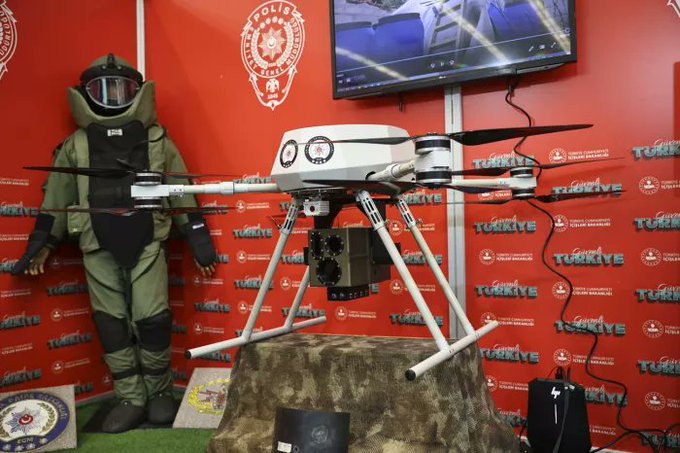
Turkey is developing a drone that can disarm bombs with a laser beam. Turkey has developed a laser beam bomb disposal drone capable of burning through carbon steel.

09
Dec
Dec
According to its inventors, rockets accelerated to several times the speed of sound in a vacuum cylinder can reduce the cost of spaceflight to a fraction of the cost. In recent years, there have been countless ideas on how to make rocket launches more economical, from reusable booster rockets to giant planes carrying space assets to the stratosphere, to futuristic space elevators. SpinLaunch has chosen a different solution, and it looks like their calculations will work.

10
Oct
Oct
Lockheed Martin has already delivered the completed AHEL laser to the Air Force, which will be tested with the AC-130J Ghostrider. The United States Air Force has long been working to make laser weapons a standard part of aircraft weaponry, and Lockheed Martin has been awarded a five-year contract in July to further develop, test and demonstrate the AHEL (airborne high energy laser) system to help achieve this.

09
Oct
Oct
Travelling faster than the speed of light without using negative energy may be feasible within the framework of Einstein’s laws of physics. The warp drive, which brings a spacecraft travelling through space to its destination by warping the fabric of space-time much faster than conventional methods, first appeared in the Star Trek series and was used to power Federation fleet vehicles, among other things.

07
Oct
Oct
Although it would only take passengers up to thirty kilometres, it would also be much cheaper than a real space trip. If the title sounds familiar, it’s not a coincidence, as World View Enterprises is the third company in recent years to solve the problem of high-altitude travel by balloon.

05
Oct
Oct
If the concept of EmDrive works, it would have redefined not only our view of space travel, but of physics as a whole. Except that the latest research shows that it really is impossible to drive anything with an “impossible drive”.