


The US Army’s new transport helicopter is scheduled to enter service by 2030, marking a significant shift in military aviation technology. The V-280 Valor, developed by Textron Bell, is set to replace the iconic UH-60 Black Hawk helicopters that have been in service since 1979. The replacement of these legendary helicopters signifies not only a technological leap but also a rethinking of the way military missions will be carried out in the future.
Background and development of the Black Hawk
The Black Hawk is a family of medium-lift, multi-purpose transport helicopters, developed and manufactured by Sikorsky in 1974. The Black Hawk has become a symbol of US military aviation, having served in numerous conflicts and proving its versatility in diverse mission profiles. It was designed during the Cold War as a key component of the US military’s mobility strategy, primarily to transport troops and supplies, conduct air assaults, and provide critical battlefield support.
For example, during Operation Gothic Serpent in 1993 (famously depicted in the film Black Hawk Down), the Black Hawk played a central role in the US military’s efforts in Somalia. Its reputation for reliability and versatility made it the go-to helicopter for various missions, including combat troop transport, air rescue, medical evacuation, and electronic warfare.
Additionally, the Black Hawk is often used to transport high-ranking government officials. When the US President travels aboard one of these helicopters, the aircraft is referred to as Marine One, showcasing its importance beyond military use. The helicopter’s ability to carry eleven armed soldiers or up to 1170 kilograms of internal cargo demonstrates its remarkable operational flexibility. In some configurations, it can even carry external loads of up to 4050 kilograms.
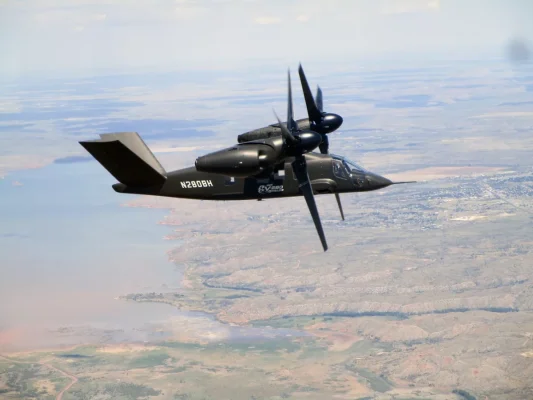
The V-280 Valor: The future of military aviation
In late 2022, the US Army awarded Textron Bell the contract to develop the V-280 Valor as part of the Future Long-Range Assault Aircraft (FLRAA) program, after the Sikorsky-Boeing team’s bid was unsuccessful. The FLRAA program aims to revolutionize the Army’s air mobility capabilities with a platform that combines the agility of a helicopter with the speed and range of a fixed-wing aircraft. The tiltrotor design of the V-280 Valor offers several advantages over traditional helicopters, particularly in speed, range, and versatility.
This decision marks a $70 billion procurement that will ultimately see the replacement of around 2,000 Black Hawk helicopters by 2030. The US Army envisions that the V-280 will be capable of conducting a wide array of missions similar to those performed by the Black Hawk but with far superior performance metrics.
Key features and capabilities
The V-280 Valor introduces groundbreaking advancements in military aviation technology. One of the most significant features of the V-280 is its tiltrotor design, which enables the aircraft to switch between helicopter-like and airplane-like flight modes. This design allows for vertical takeoff and landing, while achieving twice the speed of the Black Hawk in horizontal flight. In traditional helicopters, the main rotor provides lift for takeoff and landing, but limits speed. By rotating the V-280’s rotors to a horizontal position, the aircraft can achieve speeds of up to 280 knots (about 520 km/h), much faster than a typical helicopter.
The US Army is planning three major improvements with the V-280 Valor: increased speed, extended range, and enhanced overall performance. The aircraft is expected to have an operational range of 4,522 kilometers without refueling—significantly greater than the Black Hawk’s range. This extended range is critical for operations in large theaters, such as the Indo-Pacific region, where distances between areas of operation can be vast.
Another key capability of the V-280 is its ability to operate in contested environments. Its agility will allow it to quickly deploy troops in risky, high-threat areas, and its enhanced speed ensures that it can extract personnel just as swiftly.
Why the tiltrotor design is a game-changer
Tiltrotor technology, which is also used in the Bell Boeing V-22 Osprey, offers several operational advantages. The V-280 can take off vertically, like a helicopter, but once airborne, the rotors tilt forward to convert the aircraft into a turboprop plane. This allows for much faster horizontal flight, making the V-280 more efficient at long-range transport.
During takeoff and landing, the rotors are positioned vertically, providing lift just like a helicopter. As the aircraft accelerates and gains altitude, the rotors gradually tilt forward to a horizontal position. The fixed wing then provides the lift, while the rotors function as propellers, delivering significantly higher speeds compared to traditional helicopters. This hybrid capability will give the US Army the flexibility to operate in areas where traditional fixed-wing aircraft would be unable to land, and helicopters would be too slow to deploy effectively.
Case study: The Bell Boeing V-22 Osprey
The success of tiltrotor technology in the military can be observed in the V-22 Osprey, which has been used by the US Marine Corps since the 2000s. The V-22’s tiltrotor configuration allowed it to perform rapid troop insertions during the War in Afghanistan and Iraq, while its ability to hover like a helicopter provided excellent close support for ground troops. The V-280 Valor aims to build upon this legacy, delivering even greater speed and range while maintaining the versatility of a helicopter.
Timeline for the V-280 Valor’s deployment
The first prototype of the V-280 Valor is expected to take to the skies by 2026. If the development schedule proceeds as planned, the US Army hopes to begin small-scale initial production in 2028, with the first units entering operational service by 2030. These new aircraft will be pivotal in modernizing the Army’s aviation capabilities, offering a platform designed to meet the demands of 21st-century warfare, from rapid deployment to contested airspaces and beyond.
The replacement of the legendary Black Hawk with the V-280 Valor is more than just an aircraft swap—it represents a significant leap forward in military aviation technology. By combining the best features of helicopters and airplanes, tiltrotor aircraft like the V-280 Valor will redefine the future of military air mobility. With its improved speed, range, and versatility, the V-280 is poised to enhance the Army’s ability to respond quickly to a wide variety of mission types, ensuring the US maintains its tactical edge in the years to come.
Highlighted note:
What is tiltrotor technology? Tiltrotor aircraft combine the vertical lift capability of helicopters with the speed of airplanes. By rotating the aircraft’s rotors forward during flight, the aircraft can achieve much higher speeds than a helicopter while maintaining the ability to hover and take off vertically.
Highlighted note:
Did you know? The Bell Boeing V-22 Osprey, another tiltrotor aircraft, has been instrumental in US Marine Corps operations since the early 2000s, providing crucial air mobility in Iraq and Afghanistan.
Source: interestingengineering.com
More articles you may be interested in...
Drones News & Articles
China’s automated logistics network exposes Western regulatory inertia
Drones News & Articles
The hovering sniper: China’s new rifle-drone achieves “deadly precision”
A recent report indicates that Chinese researchers have overcome one of the primary hurdles in robotic warfare: recoil management.
EVTOL & VTOL News & Articles
Sanghajt opens up to drones
From February, drones will be able to fly over designated areas without prior notification, with the local government seeing tremendous...>>>...READ MORE
Drones News & Articles
DJI agras series: a new era in autonomous agricultural robotics
Air taxi News & Articles
The great convergence: standardizing electric flight propulsion
EVTOL & VTOL News & Articles
The tethered sky: Navigating the integration of U-space and energy grids
News & Articles Propulsion-Fuel
Hydrogen’s regional mandate: Retrofitting the future of flight
EVTOL & VTOL News & Articles
Navigating the valley of reality: An AAM sector assessment
The Advanced Air Mobility (AAM) ecosystem has fundamentally shifted, transitioning from a period defined by...>>>...READ MORE
moreDrones News & Articles
Europe’s airspace awakens: The industrial reality of U-space 2.0
News & Articles Propulsion-Fuel
Hydrogen’s verdict: The 2026 propulsion shift redefining regional flight
News & Articles Propulsion-Fuel
Solid-state inflection: The 5-minute charge revolutionizing regional aviation
The nascent electric aviation sector currently faces a defining bottleneck that has less to do...>>>...READ MORE
EVTOL & VTOL News & Articles
The certification cascade: How Part 194 rewrites the rules of vertical flight
Drones News & Articles
Beyond Formula 1: engineering the 657 km/h Peregreen V4 drone record
In the realm of aerodynamics, the quadcopter configuration has traditionally been associated with stability and...>>>...READ MORE
moreEVTOL & VTOL News & Articles
EHang appoints Shuai Feng as chief technology officer
EHang Holdings Limited (Nasdaq: EH) (“EHang” or the “Company”), a global leader in advanced air mobility (“AAM”) technology, today officially announced that the Board of Directors of the Company (the “Board”) has approved and appointed Mr. Shuai Feng as the Chief Technology Officer (“CTO”), effective on January 14, 2026.