


The development of drones capable of operating in multiple environments has garnered significant attention in recent years, particularly for applications requiring seamless transitions between aerial and aquatic domains. A team of four students from Aalborg University in Denmark has advanced this field with a novel amphibious drone that integrates a variable-pitch propeller system, enabling efficient movement in both air and water.
Related Articles
Design and functionality of the amphibious drone
The drone, developed by Andrei Copaci, Mikołaj Dzwigało, Paweł Kowalczyk, and Krzysztof Sierocki over two semesters, features a quadcopter design with four motors, each equipped with a variable-pitch propeller system. This system, driven by individual electric servo motors, allows the propeller blades to adjust their pitch axially, optimizing performance for aerial flight or underwater propulsion.
According to the principles of variable-pitch propellers, this mechanism enables real-time adjustment of the blade angle relative to the motor axis, facilitating rapid transitions between air and water.
Critical observation: The use of variable-pitch propellers represents a sophisticated engineering choice, as it addresses the differing thrust requirements of air (lower density, higher speed) and water (higher density, lower speed).
However, the reliance on servo motors introduces potential points of failure, particularly in underwater conditions where sealing and corrosion resistance are critical. Future iterations could explore more robust actuation mechanisms, such as magnetic or hydraulic systems, to enhance durability.
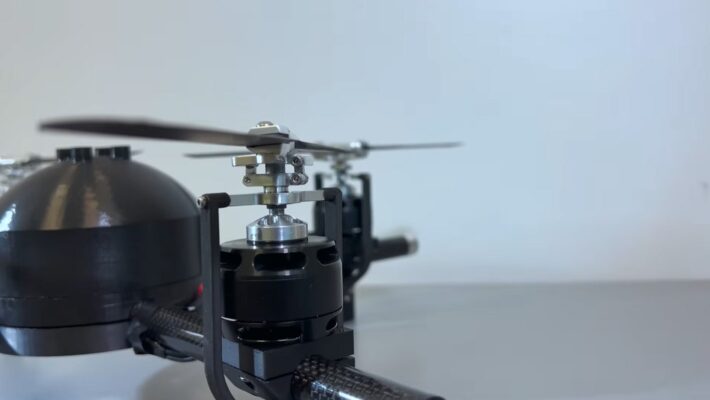
The drone’s fuselage, designed as a circular housing, encapsulates the battery and control electronics, providing a compact and potentially streamlined structure for both environments. Testing demonstrated the drone’s ability to land on water, submerge, perform underwater maneuvers, and ascend back into the air with minimal delay.
The propeller blades operate at an angle of 20–21 degrees for aerial flight and 6–9 degrees for underwater movement, showcasing the system’s adaptability.
Professional insight: The circular fuselage design, while functional, may not be fully optimized for hydrodynamic efficiency. Streamlining the housing, as suggested in the original text, could reduce drag and improve energy efficiency, particularly in water. Computational fluid dynamics (CFD) simulations, commonly used in drone design, could guide such refinements.
Amphibious Drone Insight
Variable-pitch propellers enable instant switching between air and water. The trade-off: added mechanism complexity and sealing challenges.
Further reading: Pioneering Hybrid Drone Developed for Dual Environments
Technical innovations and operational performance
The core innovation lies in the drone’s ability to switch modes instantaneously, a feat enabled by the variable-pitch propeller system. Each motor controls two blades, and the servo-driven mechanism adjusts their pitch dynamically during operation. This allows the drone to maintain maneuverability in both air and water, with the blade angle optimized for the respective medium’s viscosity and density.
Critical observation: The ability to adjust propeller pitch in real time is a significant advancement over fixed-pitch systems, which are less versatile in multimodal applications. However, the system’s complexity may increase maintenance demands and manufacturing costs, potentially limiting scalability for commercial applications. Simplifying the pitch adjustment mechanism without sacrificing performance could enhance practicality.
The drone’s performance was validated through a test demonstrating seamless transitions between aerial and aquatic environments. It landed on a pool’s surface, submerged to execute maneuvers, and ascended back into the air, highlighting the system’s responsiveness and stability.
The integration of control electronics within a sealed fuselage ensures operational reliability, though long-term testing in diverse aquatic conditions (e.g., saltwater or high-pressure environments) remains necessary.
Professional insight: The instantaneous mode-switching capability aligns with emerging trends in robotics, where adaptability to dynamic environments is increasingly valued. For instance, applications in marine research or disaster response could benefit from drones that transition seamlessly between air and water, reducing operational downtime.
However, the energy demands of rapid pitch adjustments and mode transitions warrant further investigation to optimize battery life.
Did you know?
Concise background insights that complement amphibious drone research and practice.
Contextualizing the development: Precedents and potential
While the Aalborg University drone represents a significant achievement, it builds on prior work in amphibious robotics. A notable precedent is the 2015 project by Rutgers University, which developed a similar amphibious drone, the Naviator, capable of aerial and underwater operation but reliant on a wired connection for power and control (Naviator project). The Danish team’s drone, by contrast, operates wirelessly, enhancing its autonomy and practical utility.
Critical observation: The absence of a wired connection marks a clear improvement over the Rutgers design, as it expands the drone’s operational range and flexibility. However, the original text does not clarify whether the Aalborg team drew direct inspiration from the Naviator or other projects.
Establishing a clear lineage of design influences would strengthen the academic credibility of the work and highlight iterative improvements.
The drone’s potential applications are vast, spanning environmental monitoring, search and rescue, and underwater infrastructure inspection. Its ability to operate in both air and water makes it particularly suited for tasks requiring rapid environmental transitions, such as coastal surveillance or marine ecosystem studies. However, commercial viability will depend on addressing challenges such as cost, durability, and energy efficiency.
Professional insight: The drone’s design aligns with the growing demand for versatile unmanned systems in industries like marine science and defense. For example, organizations like the National Oceanic and Atmospheric Administration (NOAA) could leverage such technology for real-time data collection in dynamic coastal environments.
Scaling the design for commercial use will require rigorous testing to ensure reliability under varying environmental conditions, such as turbulent waters or extreme temperatures.
Future directions and challenges
The Aalborg University drone demonstrates significant promise, but several areas warrant further development. Streamlining the fuselage for improved hydrodynamics, enhancing the durability of the servo-driven pitch adjustment system, and optimizing battery efficiency are critical next steps. Additionally, integrating advanced sensors, such as sonar or high-resolution cameras, could expand the drone’s utility for specialized applications.
Critical observation: The current design’s reliance on a single battery for both aerial and aquatic operations may limit endurance, particularly in water, where propulsion demands are higher. Exploring hybrid power systems or modular battery designs could address this limitation, aligning with trends in drone technology toward extended operational times.
Professional insight: The project’s success underscores the value of interdisciplinary collaboration in engineering education. By combining expertise in aerodynamics, hydrodynamics, and control systems, the Aalborg team has produced a prototype with real-world potential. Future iterations could benefit from partnerships with industry leaders, such as DJI, to refine the design for mass production and market entry.
Multimodal robotics
The amphibious drone developed by the Aalborg University team represents a significant step forward in multimodal robotics, leveraging a variable-pitch propeller system to achieve seamless transitions between aerial and aquatic environments.
While challenges remain in optimizing durability, efficiency, and scalability, the prototype’s performance highlights its potential for applications in environmental monitoring, search and rescue, and beyond. By building on precedents like the Rutgers Naviator and addressing current limitations, this technology could pave the way for a new generation of versatile unmanned systems.
More articles you may be interested in...
Drones News & Articles
China’s automated logistics network exposes Western regulatory inertia
Drones News & Articles
The hovering sniper: China’s new rifle-drone achieves “deadly precision”
A recent report indicates that Chinese researchers have overcome one of the primary hurdles in robotic warfare: recoil management.
EVTOL & VTOL News & Articles
Sanghajt opens up to drones
From February, drones will be able to fly over designated areas without prior notification, with the local government seeing tremendous...>>>...READ MORE
Drones News & Articles
DJI agras series: a new era in autonomous agricultural robotics
Air taxi News & Articles
The great convergence: standardizing electric flight propulsion
EVTOL & VTOL News & Articles
The tethered sky: Navigating the integration of U-space and energy grids
News & Articles Propulsion-Fuel
Hydrogen’s regional mandate: Retrofitting the future of flight
EVTOL & VTOL News & Articles
Navigating the valley of reality: An AAM sector assessment
The Advanced Air Mobility (AAM) ecosystem has fundamentally shifted, transitioning from a period defined by...>>>...READ MORE
moreDrones News & Articles
Europe’s airspace awakens: The industrial reality of U-space 2.0
News & Articles Propulsion-Fuel
Hydrogen’s verdict: The 2026 propulsion shift redefining regional flight
News & Articles Propulsion-Fuel
Solid-state inflection: The 5-minute charge revolutionizing regional aviation
The nascent electric aviation sector currently faces a defining bottleneck that has less to do...>>>...READ MORE
EVTOL & VTOL News & Articles
The certification cascade: How Part 194 rewrites the rules of vertical flight
Drones News & Articles
Beyond Formula 1: engineering the 657 km/h Peregreen V4 drone record
In the realm of aerodynamics, the quadcopter configuration has traditionally been associated with stability and...>>>...READ MORE
moreEVTOL & VTOL News & Articles
EHang appoints Shuai Feng as chief technology officer
EHang Holdings Limited (Nasdaq: EH) (“EHang” or the “Company”), a global leader in advanced air mobility (“AAM”) technology, today officially announced that the Board of Directors of the Company (the “Board”) has approved and appointed Mr. Shuai Feng as the Chief Technology Officer (“CTO”), effective on January 14, 2026.