


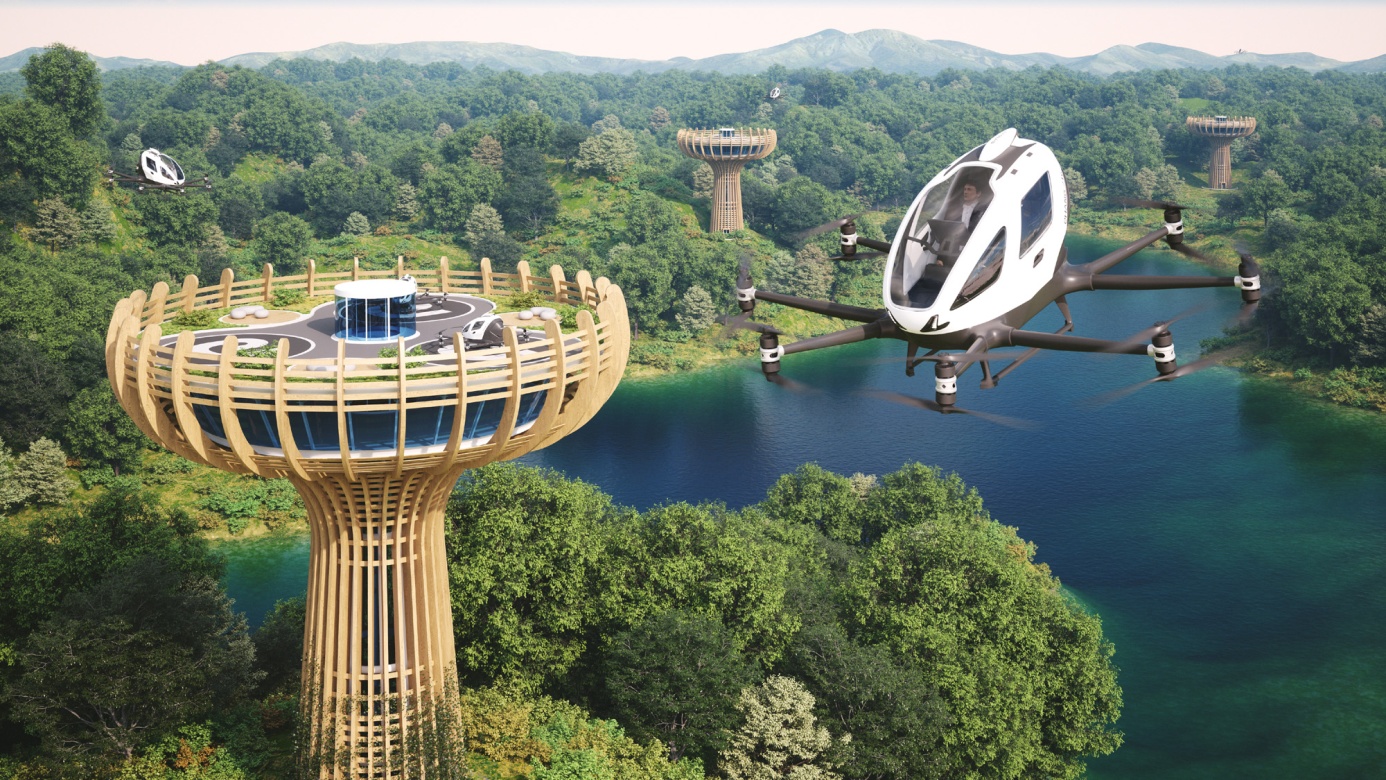
Stations made for drones can take on quite special forms, for example, Italian architects envision vertiports similar to real trees that blend into nature. Drone transport could reform the passenger transport market in the coming decades, helping travelers to reach their destination much faster by avoiding traffic jams in cities. Although flying cars maneuvering between the skyscrapers of cyberpunk cities are an integral part of the sci-fi in the future, in reality the production of flying passenger vehicles that can be used in cities is just beginning, we are still a long way from the usual sight of air travel over the streets. And instead of flying cars, drones will dominate this area, meaning we will be transported by automatic, electric vehicles instead of being able to drive our own cars in the airspace. For the time being, flying a car will be the privilege of the wealthier.
First and foremost, the institution of air taxi will lay the groundwork for drone transport within and between cities, and many companies are already making the start of this very soon. Hyundai has also begun production of the drones and EHang has also shipped forty models for testing to prospective customers. However, drones, no matter how small they can land, will need separate landing sites. Until the appropriate infrastructure is in place, efficient aviation will not be possible.
“You can’t get off and on a train unless you get to a station, so building ground infrastructure is absolutely key.”
Ricky Sandhu, founder of Urban Air-Port, told Reuters in January. Urban Air-Port will be Hyundai’s first demonstration VTOL airport, from where drones will be able to depart and return. The vertiport, which we also reported on, will be built in England and is scheduled to open in November. However, the most ideal runway for drones is the high-altitude vertiport, as landing on these towers does not disturb ground traffic and thus makes it much more convenient for passengers to get in and out. At some point in the distant future, it will even be possible to set up mini-stations on the balconies of residential buildings, but for the time being, plans focus even more on creating junctions that can perform up to several functions at once, while accommodating taxis.
The idea of the Italian architectural firm Giancarlo Zema Design Group is also based on the idea of a multifunctional airport: at the top of the thirty-meter-high towers there will be several landing sites, and below it will be a restaurant with 360-degree panoramic views of the surrounding landscape. Passengers will be transported to the ground floor by an elevator in the middle, and the building will be based entirely on the principles of sustainable architecture, meaning the tower will be partly made of wood, solar panels will generate energy and vegetation will be installed on the roof. In this way, VTOL vehicles will be able to be charged with clean energy, and solar panels will be able to generate roughly 300 kW of energy per day.
The special shape of the towers is similar to the African monkey bread trees, these are the special-looking, iconic, hollow trees inside that, according to legend, used to be used as prisons at times. The vertiports, named Baobab after the monkey breadfruit tree, will be made for EHang, but the architectural firm has only outlined the visual plans, it is not yet known when and exactly where the landing sites will be built.
More articles you may be interested in...
Drones News & Articles
China’s automated logistics network exposes Western regulatory inertia
Drones News & Articles
The hovering sniper: China’s new rifle-drone achieves “deadly precision”
A recent report indicates that Chinese researchers have overcome one of the primary hurdles in robotic warfare: recoil management.
EVTOL & VTOL News & Articles
Sanghajt opens up to drones
From February, drones will be able to fly over designated areas without prior notification, with the local government seeing tremendous...>>>...READ MORE
Drones News & Articles
DJI agras series: a new era in autonomous agricultural robotics
Air taxi News & Articles
The great convergence: standardizing electric flight propulsion
EVTOL & VTOL News & Articles
The tethered sky: Navigating the integration of U-space and energy grids
News & Articles Propulsion-Fuel
Hydrogen’s regional mandate: Retrofitting the future of flight
EVTOL & VTOL News & Articles
Navigating the valley of reality: An AAM sector assessment
The Advanced Air Mobility (AAM) ecosystem has fundamentally shifted, transitioning from a period defined by...>>>...READ MORE
moreDrones News & Articles
Europe’s airspace awakens: The industrial reality of U-space 2.0
News & Articles Propulsion-Fuel
Hydrogen’s verdict: The 2026 propulsion shift redefining regional flight
News & Articles Propulsion-Fuel
Solid-state inflection: The 5-minute charge revolutionizing regional aviation
The nascent electric aviation sector currently faces a defining bottleneck that has less to do...>>>...READ MORE
EVTOL & VTOL News & Articles
The certification cascade: How Part 194 rewrites the rules of vertical flight
Drones News & Articles
Beyond Formula 1: engineering the 657 km/h Peregreen V4 drone record
In the realm of aerodynamics, the quadcopter configuration has traditionally been associated with stability and...>>>...READ MORE
moreEVTOL & VTOL News & Articles
EHang appoints Shuai Feng as chief technology officer
EHang Holdings Limited (Nasdaq: EH) (“EHang” or the “Company”), a global leader in advanced air mobility (“AAM”) technology, today officially announced that the Board of Directors of the Company (the “Board”) has approved and appointed Mr. Shuai Feng as the Chief Technology Officer (“CTO”), effective on January 14, 2026.